Description
Bst-XT WarmStart™ DNA Polymerase is an engineered variant of Bacillus stearothermophilus DNA Polymerase, Large Fragment fused to a novel nucleic acid binding domain for improved isothermal amplification performance. This enzyme combines the high specificity of Bst 2.0 and the fast polymerization speed of Bst 3.0 DNA polymerases.
| |
Bst-XT WarmStart
NEB #M9204 |
Bst 2.0 WarmStart
NEB #M0538 |
Bst 3.0
NEB #M0374 |
 Amplification Speed Amplification Speed |
★★★★★ |
★★★ |
★★★★★ |
 Specificity Specificity |
★★★★★ |
★★★★★ |
★★ |
 Room temp. set-up? Room temp. set-up? |
Enabled |
Enabled |
Not recommended |
| Optimal LAMP temp |
50-70°C |
60-70°C |
55-72°C |
 Available glycerol-free Available glycerol-free |
Yes
NEB #M9205 |
Yes
NEB #M0402 |
Yes
NEB #M0443 |
★★★★★ = optimal, recommended product for selected application
★★ or ★★★ = will perform selected application
★ = may perform but not recommended
Bst-XT WarmStart DNA Polymerase contains a reversibly bound aptamer, which inhibits polymerase activity at room temperature. The aptamer rapidly releases above 45°C, therefore no separate activation step is needed.
Bst-XT WarmStart DNA Polymerase contains 5´→3´ DNA polymerase activity with either DNA or RNA templates and strong strand displacement activity, but lacks 5´→3´ and 3´→5´ exonuclease activity.
To support lyophilization, incorporation into microfluidic devices, and rapid adoption into automated workflows, Bst-XT WarmStart DNA Polymerase is available in a glycerol-free format. For added convenience, it is also offered as a master mix.
Figure 1: Bst-XT WarmStart™ DNA Polymerase combines the high specificity of Bst 2.0 WarmStart® DNA Polymerase with the fast amplification speed of Bst 3.0 DNA Polymerase
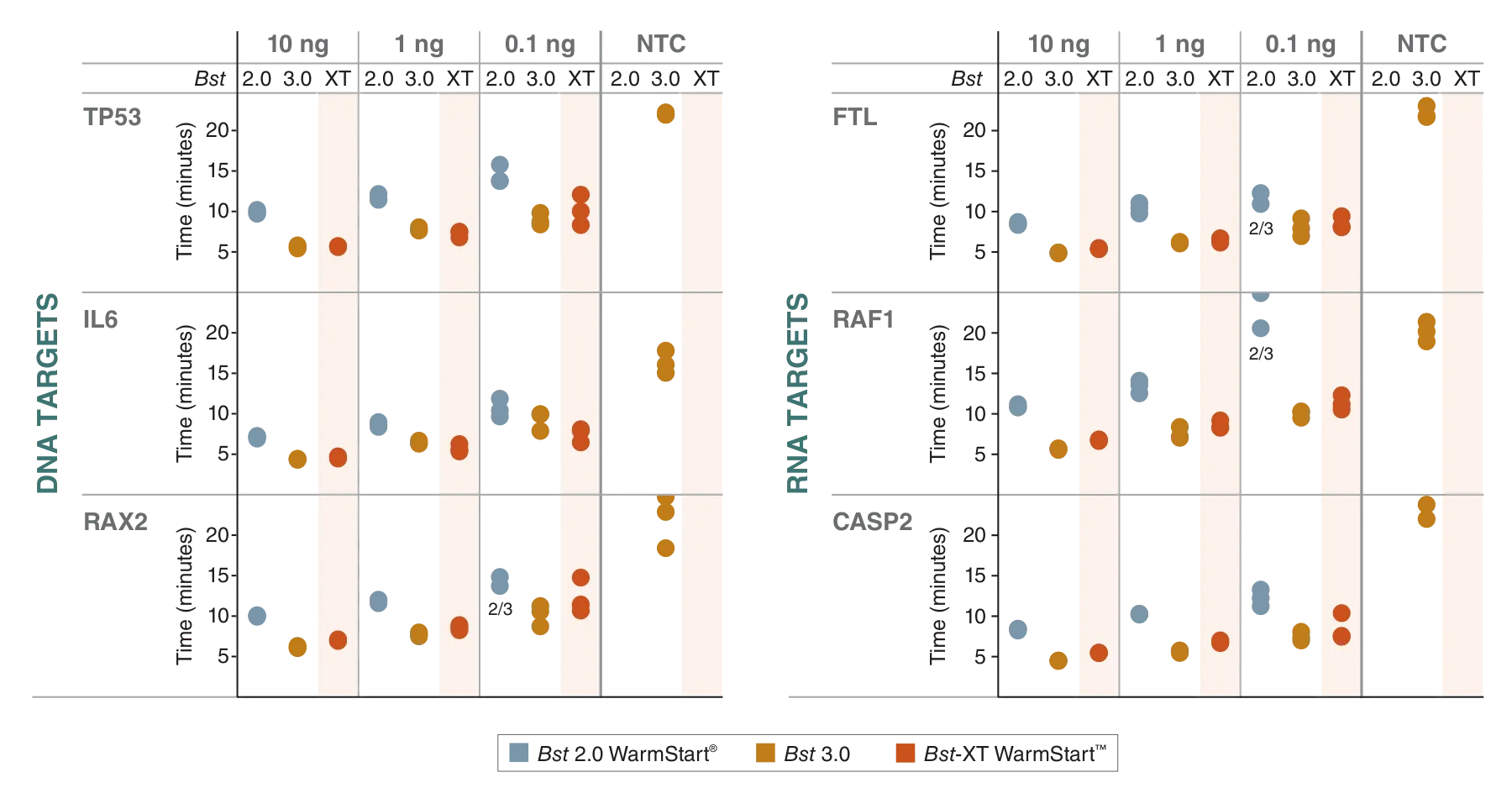
LAMP (DNA targets, left panel) or RT-LAMP (RNA targets, right panel) experiments were performed with Bst 2.0 WarmStart DNA Polymerase (NEB #M0538), Bst 3.0 DNA Polymerase (NEB #M0374), and Bst-XT WarmStart™ DNA Polymerase (NEB #M9204) in their respective isothermal amplification buffers. To detect RNA targets, WarmStart RTx Reverse Transcriptase (NEB #M0380) was included in testing. Reactions containing 1X LAMP primers and 0.5X LAMP Fluorescent Dye (NEB #B1700) were set up in triplicate over three logs of total human Jurkat total RNA or Jurkat gDNA (10 ng to 0.1 ng) in 96-well, 25 µl reactions. Control reactions without template (NTC) were also evaluated. Reactions were incubated at 65°C for 30 minutes and fluorescence was monitored every 15 seconds in the SYBR/FAM channel of a real-time thermocycler (Bio-Rad® CFX96). Each dot represents the time at which the fluorescence signal for a single reaction crosses the instrument-defined threshold. All three replicates were detected at each template input unless otherwise indicated (note that dots frequently overlap given similar detection time for the replicates). Overall, Bst-XT WarmStart DNA Polymerase showed similar time to detection for all template inputs to Bst 3.0 but without amplification in the no template controls. This data highlights that Bst-XT WarmStart DNA Polymerase combines the specificity of Bst 2.0 WarmStart DNA polymerase and the amplification speed of Bst 3.0 DNA Polymerase.
Figure 2: Bst-XT WarmStart™ DNA Polymerase can be used to perform LAMP reactions across a broader range of temperatures than either Bst 2.0 WarmStart® DNA Polymerase or Bst 3.0 DNA polymerase
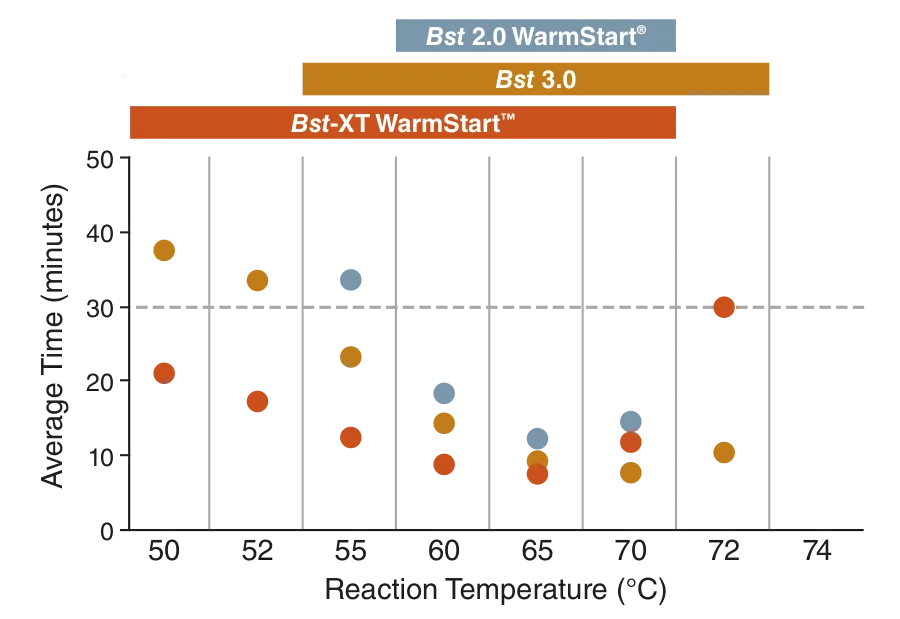
LAMP (DNA target VEGFA) experiment was performed using Bst 2.0 WarmStart DNA Polymerase (NEB #M0538), Bst 3.0 DNA Polymerase (NEB #M0374), and Bst-XT WarmStart DNA Polymerase (NEB #M9204) in their respective isothermal amplification buffers. Reactions containing 1X LAMP primers and 0.5X LAMP Fluorescent Dye (NEB #B1700) were set up using Jurkat gDNA at 1 ng input in 96-well, 25 µl reactions. Reactions were incubated at temperatures ranging between 50-74°C for 60 minutes and fluorescence was monitored every 15 seconds in the SYBR/FAM channel of a real-time thermocycler (Bio-Rad® CFX96). Each dot represents the average of three replicates for time to detection, which is the time at which the fluorescence signal crosses the instrument-defined threshold. Bst-XT WarmStart DNA Polymerase was able to detect 1 ng of target within 30 minutes at reaction temperatures ranging from 50°C-70°C. Bst 2.0 WarmStart DNA Polymerase showed optimal detection at temperatures between 60°C-70°C, while the optimum temperature for Bst 3.0 DNA polymerase ranged from 55°C-72°C. This data highlights that Bst-XT WarmStart DNA Polymerase can be used to perform LAMP reactions across a broader range of temperatures than either Bst 2.0 WarmStart DNA Polymerase or Bst 3.0 DNA polymerase.
- This product is related to the following categories:
-
Isothermal Amplification & Strand Displacement
- This product can be used in the following applications:
-
Loop-Mediated Isothermal Amplification,
-
Isothermal Amplification