Description
Based on the Vaccinia virus Capping Enzyme (VCE), the Vaccinia Capping System provides the necessary components to add 7-methylguanylate cap structures (Cap-0) to the 5´end of RNA (1). In eukaryotes, these terminal cap structures are involved in stabilization (2), transport (3), and translation (4) of mRNAs. Enzymatic production of capped RNA is an easy way to improve the stability and translational competence of RNA used for in vitro translation, transfection, and microinjection. Alternatively, use of labeled GTP in a reaction provides a convenient way to label any RNA containing a 5´ terminal triphosphate.
Vaccinia capping enzyme is composed of two subunits (D1 and D12). The D1 subunit carries three enzymatic activities (RNA triphosphatase, guanylyltransferase and guanine methyltransferase); all necessary for addition of a complete Cap-0 structure, m7Gppp5'N to 5' triphosphate RNA (5,6). In vitro transcripts can be capped in less than one hour in the presence of the capping enzyme, reaction buffer, GTP, and the methyl donor, SAM. Capping is nearly 100% efficient and all capped structures are added in the proper orientation, unlike co-transcriptional addition of some cap analogs (7).
Figure 1: mRNA 5´ cap structures
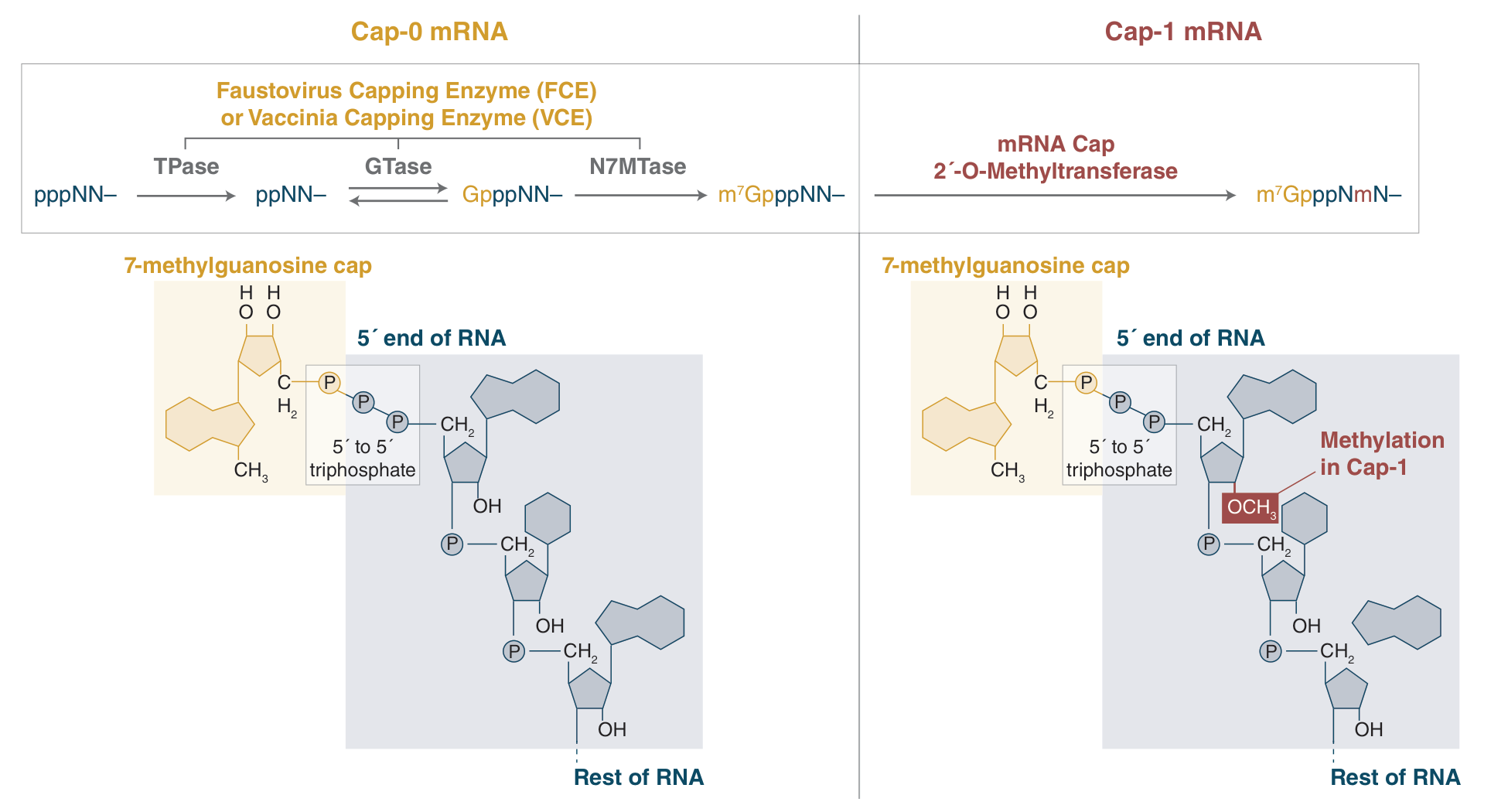
Schematic representation of mRNA 5´ Cap-0 and Cap-1 structures indicating the 7-methylguanosine, shown in yellow, and the 5´ end of the mRNA, shown in blue. The 2´-O-methyl group present in the Cap-1 and Cap-1 structure is shown in red.
Product Source
An E. coli strain that carries a plasmid encoding engineered His-tagged Vaccinia Capping Enzyme genes.
- This product is related to the following categories:
-
RNA Capping,