Product Class: Other

TET2
Gray property icon for NEBU Gray property icon for cloned at NEB recombinant Gray property icon for incubation temperature 37° Gray property icon for heat inactivation no

Product Introduction

  • Demethylase
  • Oxidizes 5-methylcytosine (5mC) through an iterative reaction into 5-hydroxymethylcytosine (5hmC), 5-formylcytosine (5fC),
    and 5-carboxycytosine (5caC)
  • Enables enzymatic strategies for sensitive detection of epigenetic modifications to cytosines
Bioz Badge Exists : True
Catalog # Size Concentration
M1524S 400 units 8000 units/ml
M1524L 2000 units 8000 units/ml

Product Information

Description

TET2 (Tet methylcytosine dioxygenase 2) is a demethylase and ten-eleven translocation protein.

TET enzymes play a crucial role in DNA demethylation by oxidizing 5-methylcytosine (5mC), a key epigenetic marker, in a stepwise manner to 5-hydroxymethylcytosine (5hmC), 5-formylcytosine (5fC) and 5-carboxycytosine (5caC)1-2. TET2 exhibits activity across various sequence contexts, including CpG, CHH, and CHG sites, whether hemi- or fully methylated3. However, the sequences flanking the target 5mC site influence the level of catalytic activity, with a preference for CG contexts. This sequence preference diminishes after the initial oxidation of 5mC to 5hmC4. Although 5mC is predominantly found in CpG sites within mammalian genomes, DNA methylation contexts are more diverse in both invertebrate and plant genomes5.


Figure 1: TET Oxidation
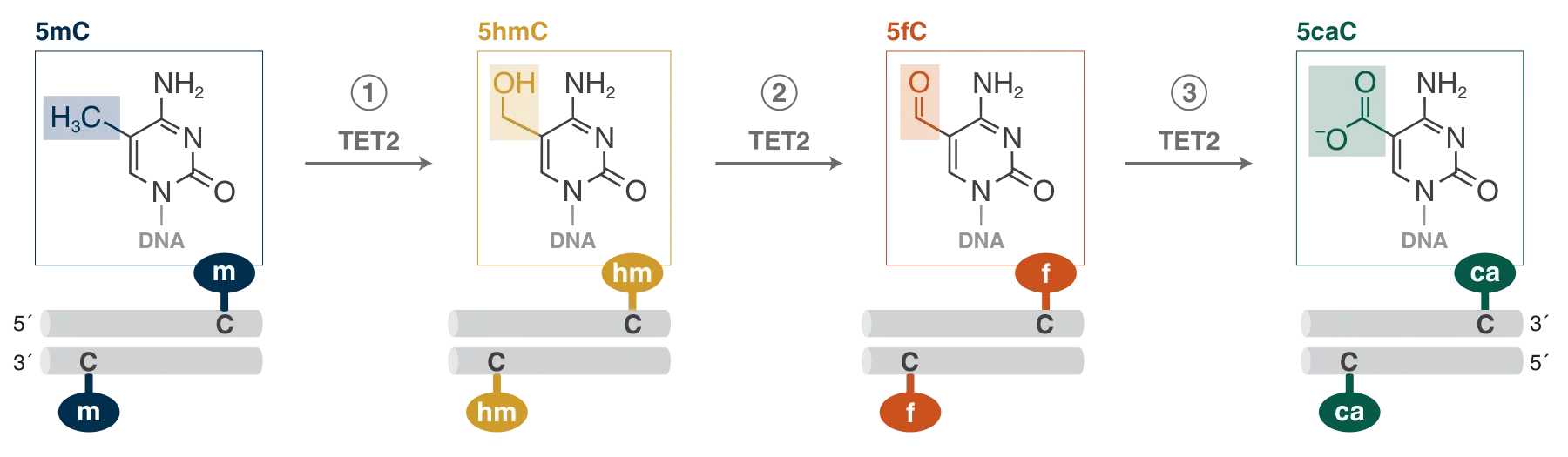
TET2 conversion of 5-methylcytosine (5mC) to 5-hydroxymethylcytosine (5hmC), then 5-formylcytosine (5fC) and finally 5-carboxycytosine (5caC)

In the presence TET2 Reaction Buffer Supplement and Fe(II), TET2 oxidizes 5-methylcytosine (5mC) in three consecutive steps to 5-hydroxymethylcytosine (5hmC), 5-formylcytosine (5fC), and 5-carboxycytosine (5caC), producing both succinate (Suc) and CO2 as byproducts..


Product Source

An E. coli strain that carries a cloned TET2 gene.
This product is related to the following categories:
Base Modifying Enzymes,
DNA Methylation Analysis,
DNA Modifying Enzymes & Cloning Technologies,

Reagents Supplied

Reagents Supplied

The following reagents are supplied with this product:

NEB # Component Name Component # Stored at (°C) Amount Concentration
  • NEB # Stored at (°C)
    M1524S -20
  • NEB # Stored at (°C)
    M1524L -20

Properties & Usage

Materials Required but not Supplied

Unit Definition

One unit is defined as the amount of enzyme required to modify 1.4 pmol of a 21-mer fluorescently labeled oligonucleotide duplex containing a central methylated CpG moiety in a total reaction volume of 20 µl in 1 hour at 37°C.

Reaction Conditions

1X TET2 Reaction Buffer
Incubate at 37°C

Heat Inactivation

No

Unit Assay Conditions

A fluorescently labeled dsDNA oligonucleotide containing a single 5mC is incubated with 1 unit of TET2 in 1X TET2 Reaction Buffer (containing supplement and Fe2+). 1 unit of TET2 must modify ≥80% of 1.75 pmol of substrate as determined by capillary electrophoresis.

Features

  • Specifically oxidizes 5mC, to 5hmC, 5fC, and 5caC in a stepwise manner.

Product Notes

  1. For enzymes that cannot be heat-inactivated, we recommend using a column for cleanup (such as the Monarch® PCR & DNA Cleanup Kit, NEB #T1130) or treatment with Thermolabile Proteinase K (NEB #P8111).
  2. TET2 is active across a wide temperature range (4-80°C). Optimal temperature is 37°C.
  3. Under nonstandard conditions, TET2 activity can become sensitive to sequence context.
  4. The methylation status on the opposing strand does not impact TET2 activity.

References

  1. Crawford D, et al. (2016). Tet2 Catalyzes Stepwise 5-methylcytosine Oxidation by an Iterative and de novo Mechanism. 138(3), 730-733. J. Am. Chem. Soc.
  2. Vaisvila R, et al. (2021). Enzymatic methyl sequencing detects DNA methylation at single-base resolution from picograms of DNA. 31(7), 1280-1289. Genome Research.
  3. Ravichandran M, et al. (2022). Pronounced sequence specificity of the TET enzyme catalytic domain guides its cellular function. 8(36), Science Advances.
  4. DeNizio J, et al. (2022). TET-TDG active DNA demethylation at CpG and non-CpG site. 433(8), 166877. J Mol Bio.
  5. WU H, et al. (2014). Reversing DNA Methylation: Mechanisms, Genomics, and Biological Function. 156(1-2), 45-68. Cell.

FAQs & Troubleshooting

FAQs

  1. Can TET2 (NEB #M1524) be heat inactivated?
  2. Can the freshly diluted Fe(II) Solution be stored long term?
  3. Can the reconstituted 1X TET2 Reaction Buffer Supplement (supplied with NEB #M1524) be stored longer than 4 months?
  4. Does TET2 (NEB #M1524) exhibit any sequence preference?
  5. How long can the lyophilized TET2 Reaction Buffer Supplement (supplied with NEB #M1524) be stored?
  6. Is it normal if the Fe(II) solution is yellow or a color change is observed?
  7. Is TET2 (NEB #M1524) active on asymmetrically methylated substrates?
  8. Is TET2 (NEB #M1524) active on methylated RNA?
  9. Is TET2 (NEB #M1524) active on methylated single stranded DNA?
  10. Is TET2 (NEB #M1524) inhibited by EDTA?
  11. Is TET2 (NEB #M1524) inhibited by salt?
  12. What is the activity of TET2 (NEB #M1524) in other buffers?
  13. What is the reaction temperature range for TET2 (NEB #M1524)?

Quality, Safety & Legal

Quality Assurance Statement

Quality Control tests are performed on each new lot of NEB product to meet the specifications designated for it. Specifications and individual lot data from the tests that are performed for this particular product can be found and downloaded on the Product Specification Sheet, Certificate of Analysis, data card or product manual. Further information regarding NEB product quality can be found here.

Specifications

The Specification sheet is a document that includes the storage temperature, shelf life and the specifications designated for the product. The following file naming structure is used to name these document files: [Product Number]_[Size]_[Version]

Certificate Of Analysis

The Certificate of Analysis (COA) is a signed document that includes the storage temperature, expiration date and quality controls for an individual lot. The following file naming structure is used to name these document files: [Product Number]_[Size]_[Version]_[Lot Number]

Safety DataSheets

The following is a list of Safety Data Sheet (SDS) that apply to this product to help you use it safely.

Legal and Disclaimers

Products and content are covered by one or more patents, trademarks and/or copyrights owned or controlled by New England Biolabs, Inc (NEB). The use of trademark symbols does not necessarily indicate that the name is trademarked in the country where it is being read; it indicates where the content was originally developed. The use of this product may require the buyer to obtain additional third-party intellectual property rights for certain applications. For more information, please email busdev@neb.com.

This product is intended for research purposes only. This product is not intended to be used for therapeutic or diagnostic purposes in humans or animals.

New England Biolabs (NEB) is committed to practicing ethical science – we believe it is our job as researchers to ask the important questions that when answered will help preserve our quality of life and the world that we live in. However, this research should always be done in safe and ethical manner. Learn more.

Licenses

Notice to Purchaser: No rights are conveyed for the use of this product in NEB’s EM-seq technology, which is covered by patents on compositions and/or methods including US Patent Nos.10,227,646, 10,260,088, 10,619,200, 11,001,876, and 11,124,825; EP3368688; JP6224689; and CN108699598, and corresponding pending patent applications. Use of this product for NEB’s EM-seq technology requires a license from NEB. For more information, please email busdev@neb.com.