Product Class: Other

Exo-CIP™ Rapid PCR Cleanup Mix

This product replaces Exo-CIP™ Rapid PCR Cleanup Kit.

Product Introduction

  • Simplify your workflow with a convenient one-tube formulation
  • Rapidly degrade residual PCR primers and dephosphorylate excess dNTPs after amplification
  • Save time with a rapid 4-minute reaction
  • Streamline workflows with a thermolabile formulation inactivated in 1 minute at 80°C
  • Move directly to downstream applications without additional cleanup steps
 
Bioz Badge Exists : True
Catalog # Size Concentration
M1058S 100 reactions 3.5 X
M1058L 500 reactions 3.5 X

Product Information

Description

The Exo-CIP Rapid PCR Cleanup Mix is a single-tube enzyme blend containing thermolabile Exonuclease I and thermolabile Calf Intestinal Phosphatase (CIP) in an optimized formulation and is used to rapidly degrade residual PCR primers and dephosphorylate excess dNTPs after amplification. Degradation occurs in only 4 minutes at 37°C, and is immediately followed by rapid inactivation of the enzymes by heating for 1 minute at 80°C. In just 5 minutes, the PCR product is ready for downstream analysis, such as Sanger Sequencing, SNP detection, or library preparation for NGS. The Exo-CIP Rapid PCR Cleanup Mix is compatible with all commonly-used PCR buffers.


Figure 1: Exo-CIP Rapid PCR Cleanup Mix workflow
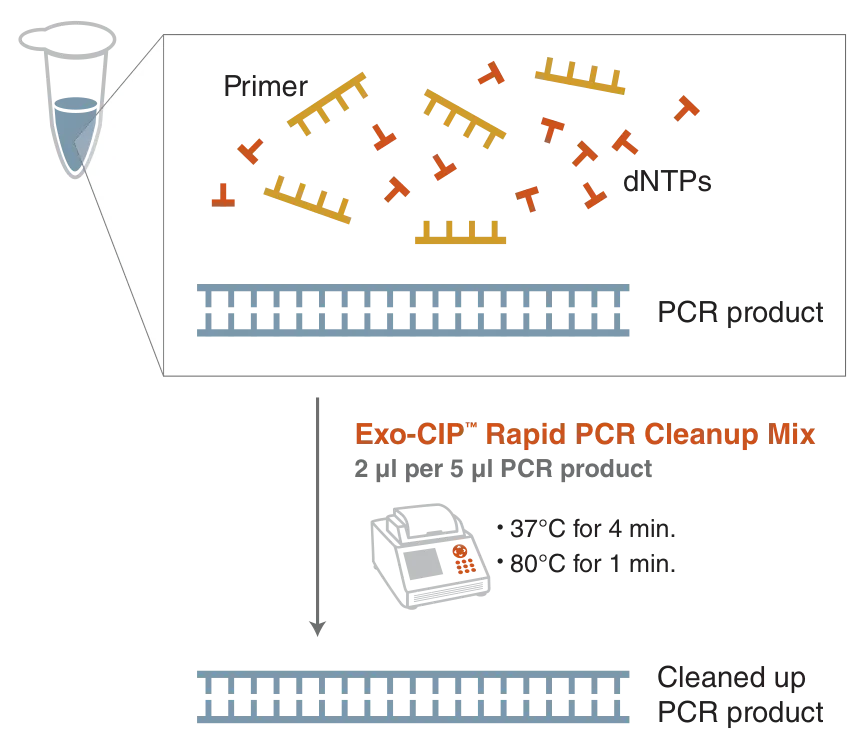
Exo-CIP™ Rapid PCR Cleanup Mix workflow 
2 µl of Exo-CIP Rapid PCR Cleanup Mix is added to the PCR product to degrade excess primers and dNTPs. The mixture is incubated at 37°C for 4 minutes, followed by a 1-minute incubation at 80°C to irreversibly inactivate both enzymes. The cleaned PCR product is ready for downstream applications or analysis.

Figure 2: Exo-CIP Rapid Cleanup Mix enables consistent read lengths for amplicons of varying lengths
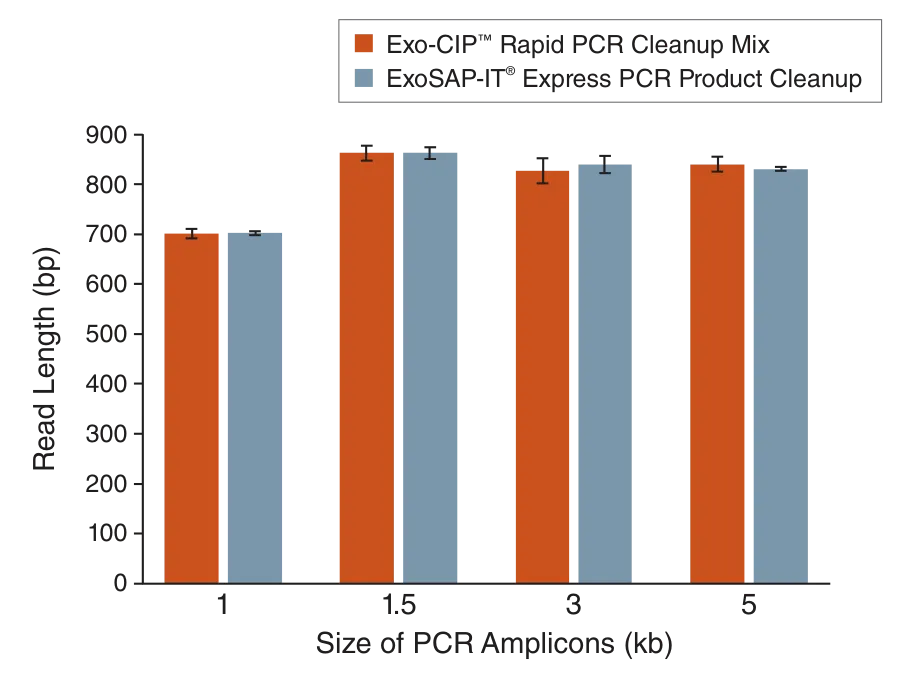
Bar graph comparing read length for various sized amplicons for Exo-CIP™ Rapid PCR Cleanup Mix and ExoSAP-IT™ Express PCR Product Cleanup 
PCR products of varying lengths were treated with Exo-CIP Rapid PCR Cleanup Mix or ExoSAP-IT® Express PCR Product Cleanup (Thermo Fisher Scientific) following the manufacturer's recommended protocols. 3 µl of the treated samples were used as input for Sanger sequencing. Samples treated with Exo-CIP Rapid PCR Cleanup Mix yielded read lengths over 650 bases, matching samples treated with ExoSAP-IT Express PCR Product Cleanup.

Figure 3: Comparison of sequencing results with Exo‑CIP Rapid PCR Cleanup Mix
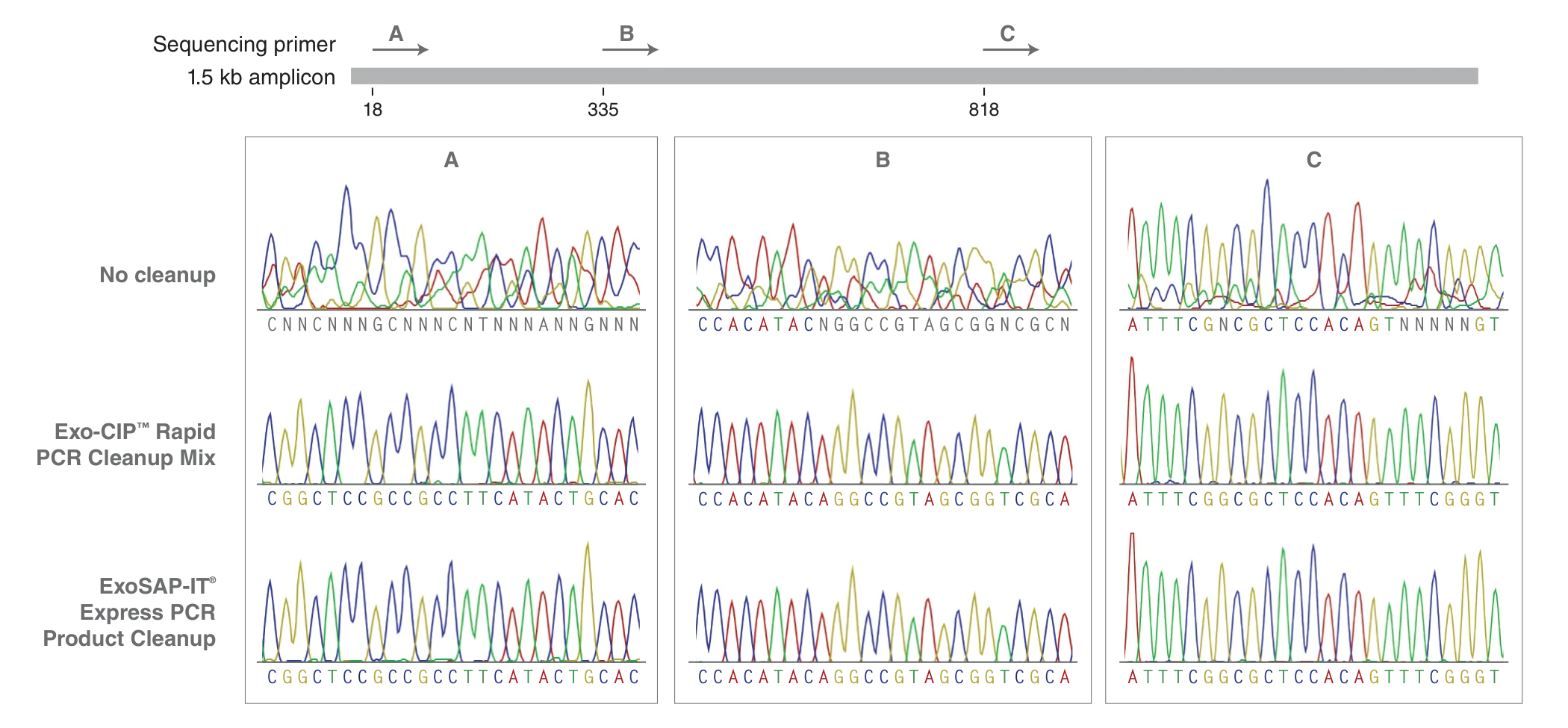
Comparison of sequencing data for no cleanup, cleanup with Exo-CIP Rapid PCR Cleanup Mix and cleanup with ExoSAP-IT™ Express PCR Product Cleanup on a 1.5 kb amplicon 
A 1.5 kb PCR amplicon was treated with Exo‑CIP Rapid PCR Cleanup Mix prior to Sanger sequencing. Cleanup eliminated miscalls and reduced background interference compared to untreated controls. Sequencing chromatograms were evaluated at multiple positions along the amplicon using three primers binding at distinct locations. Sequencing quality obtained with Exo‑CIP Rapid PCR Cleanup Mix was comparable to ExoSAP‑IT Express PCR Product Cleanup.

This product is related to the following categories:
PCR & DNA Cleanup,
Nucleic Acid Purification,
This product can be used in the following applications:
PCR & Reaction Cleanup,
DNA Amplification, PCR & qPCR

Reagents Supplied

Reagents Supplied

The following reagents are supplied with this product:

NEB # Component Name Component # Stored at (°C) Amount Concentration

Properties & Usage

FAQs & Troubleshooting

FAQs

  1. What are the differences between Exo-CIP Rapid PCR Cleanup Mix (NEB #M1058) and the Exo-CIP Rapid PCR Cleanup Kit (NEB #E1050)?
  2. Do I have to purify my PCR amplicon after cleanup with Exo-CIP Rapid PCR Cleanup Mix (NEB #M1058)?
  3. How should I store my treated samples after the enzymatic cleanup reaction using Exo-CIP Rapid PCR Cleanup Mix (NEB #M1058)?
  4. Why do I see two peaks (one large and one small) overlapping at a single position in the electropherogram after using the Exo-CIP Rapid PCR Cleanup Mix (NEB #M1058)?
  5. Is my master mix / PCR buffer compatible with the Exo-CIP Rapid PCR Cleanup Mix (NEB #M1058)?

Quality, Safety & Legal

Quality Assurance Statement

Quality Control tests are performed on each new lot of NEB product to meet the specifications designated for it. Specifications and individual lot data from the tests that are performed for this particular product can be found and downloaded on the Product Specification Sheet, Certificate of Analysis, data card or product manual. Further information regarding NEB product quality can be found here.

Specifications

The Specification sheet is a document that includes the storage temperature, shelf life and the specifications designated for the product. The following file naming structure is used to name these document files: [Product Number]_[Size]_[Version]

Certificate Of Analysis

The Certificate of Analysis (COA) is a signed document that includes the storage temperature, expiration date and quality controls for an individual lot. The following file naming structure is used to name these document files: [Product Number]_[Size]_[Version]_[Lot Number]

Safety DataSheets

The following is a list of Safety Data Sheet (SDS) that apply to this product to help you use it safely.

Legal and Disclaimers

Products and content are covered by one or more patents, trademarks and/or copyrights owned or controlled by New England Biolabs, Inc (NEB). The use of trademark symbols does not necessarily indicate that the name is trademarked in the country where it is being read; it indicates where the content was originally developed. The use of this product may require the buyer to obtain additional third-party intellectual property rights for certain applications. For more information, please email busdev@neb.com.

This product is intended for research purposes only. This product is not intended to be used for therapeutic or diagnostic purposes in humans or animals.

New England Biolabs (NEB) is committed to practicing ethical science – we believe it is our job as researchers to ask the important questions that when answered will help preserve our quality of life and the world that we live in. However, this research should always be done in safe and ethical manner. Learn more.