Description
Ribonuclease R (RNase R) is a processive 3´ to 5´ exoribonuclease (1,2). RNase R requires a 3´ single-stranded RNA substrate that is approximately 10 nucleotides or longer, such as a poly (A) tail, for proper binding (3,4,5). RNase R is unique from other exoribonucleases for its ability to degrade highly structured RNAs without the need for an additional helicase (2,6,7). Circular RNAs and lariat RNAs are enriched after RNase R digestion as these closed RNA structures are resistant to exoribonucleases (8).
Figure 1. RNase R digests linear RNA with an accessible 3´ end
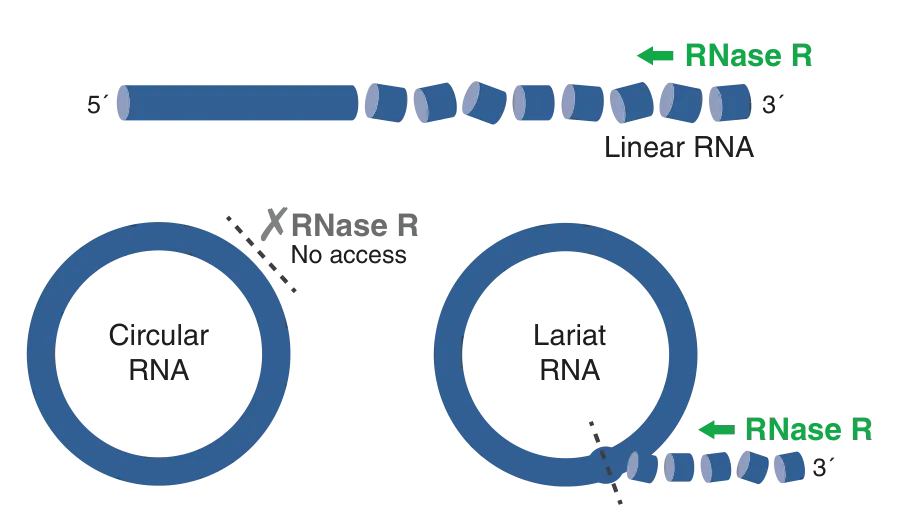
RNase R digests linear RNA with an accessible 3´ end and can be used to enrich for circular and lariat RNA. RNase R can be used to digest linear RNAs. Circular RNAs are closed RNA molecules that are resistant to RNase R digestion. Lariat RNAs have a looped structure with a single-stranded RNA region at the 3´ end. RNase R can digest the linear RNA at the 3´ end, but stops at the branch point of the lariat, preserving the looped RNA.
Figure 2. RNase R efficiently degrades linear RNA and leaves circular RNA intact
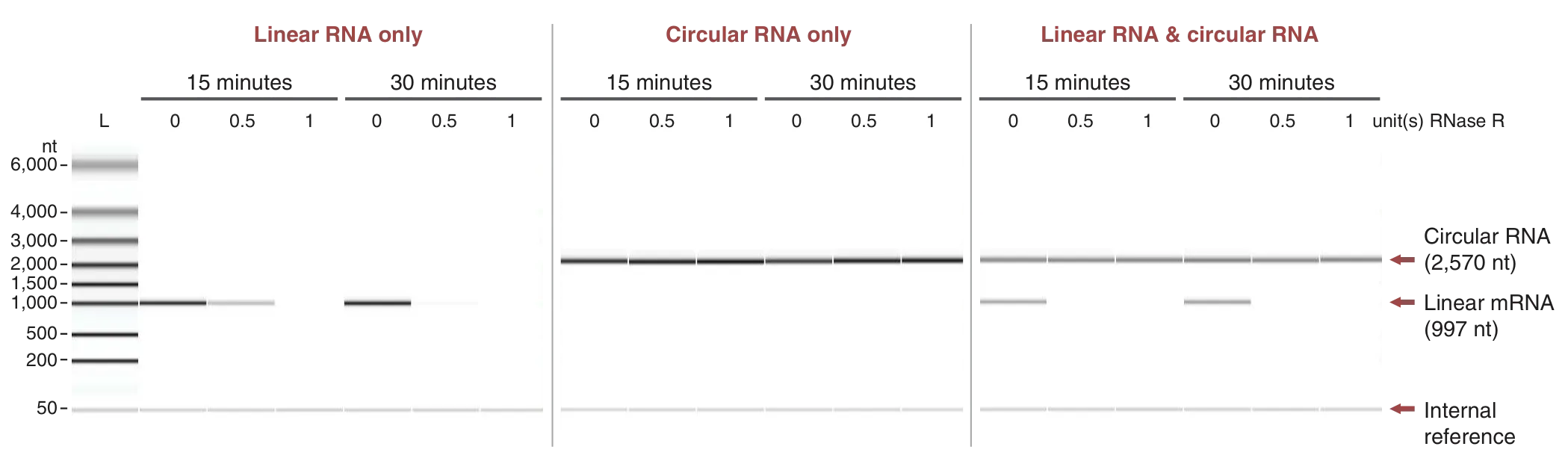
NEB® RNase R efficiently degrades linear RNA and leaves circular RNA intact. Adding 1 unit of NEB RNase R per 1 µg of RNA sample containing only linear RNA, only circular RNA, or both linear and circular RNA results in circular RNA maintenance and linear RNA digestion. This reaction ran for 15 or 30 minutes at 37°C in 1X RNase R Reaction Buffer.
Product Source
An E. coli strain that carries the cloned RNase R gene (rnr) from Escherichia coli with an N-terminal 6xHis-tag.
- This product is related to the following categories:
-
RNases,
-
RNA Modification,