Description
The NEBNext Library Quant Kit for Ultima Genomics delivers reliable and streamlined qPCR-based quantitation for Ultima Genomics Solaris Free compatible libraries. The kit includes primers specific to Ultima Genomics adaptor sequences, and a set of five high-quality, pre-diluted DNA standards to enable reliable quantitation of diluted DNA libraries.
Each set of reagents is functionally validated with qPCR-based library quantitation assays. Reagents must pass the functional test by adhering to stringent criteria set for assay efficiency and quantitation cycles (Cq) for each DNA standard and no-template control reaction.
Figure 1. NEBNext® Library Quant Kit for Ultima Genomics® workflow
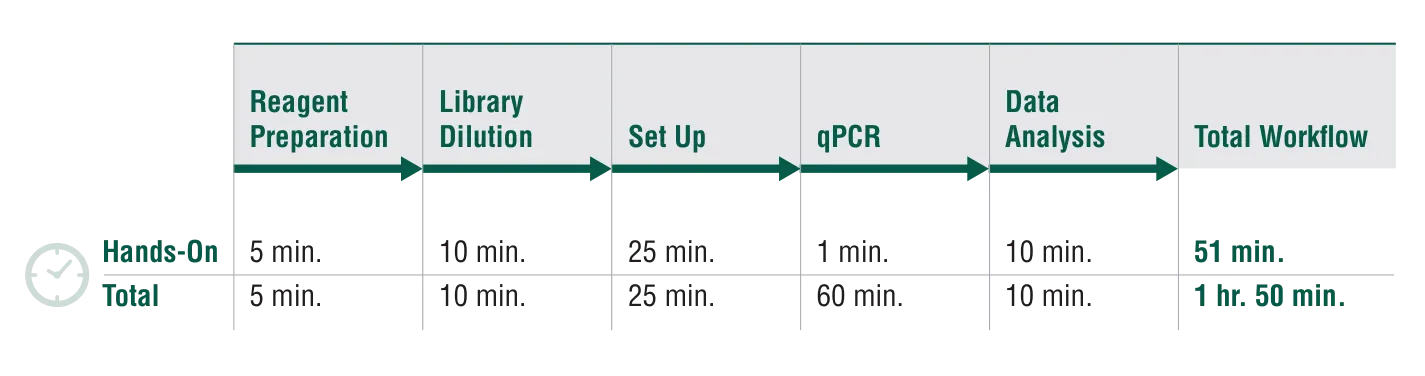
Figure 2. Typical amplification curves
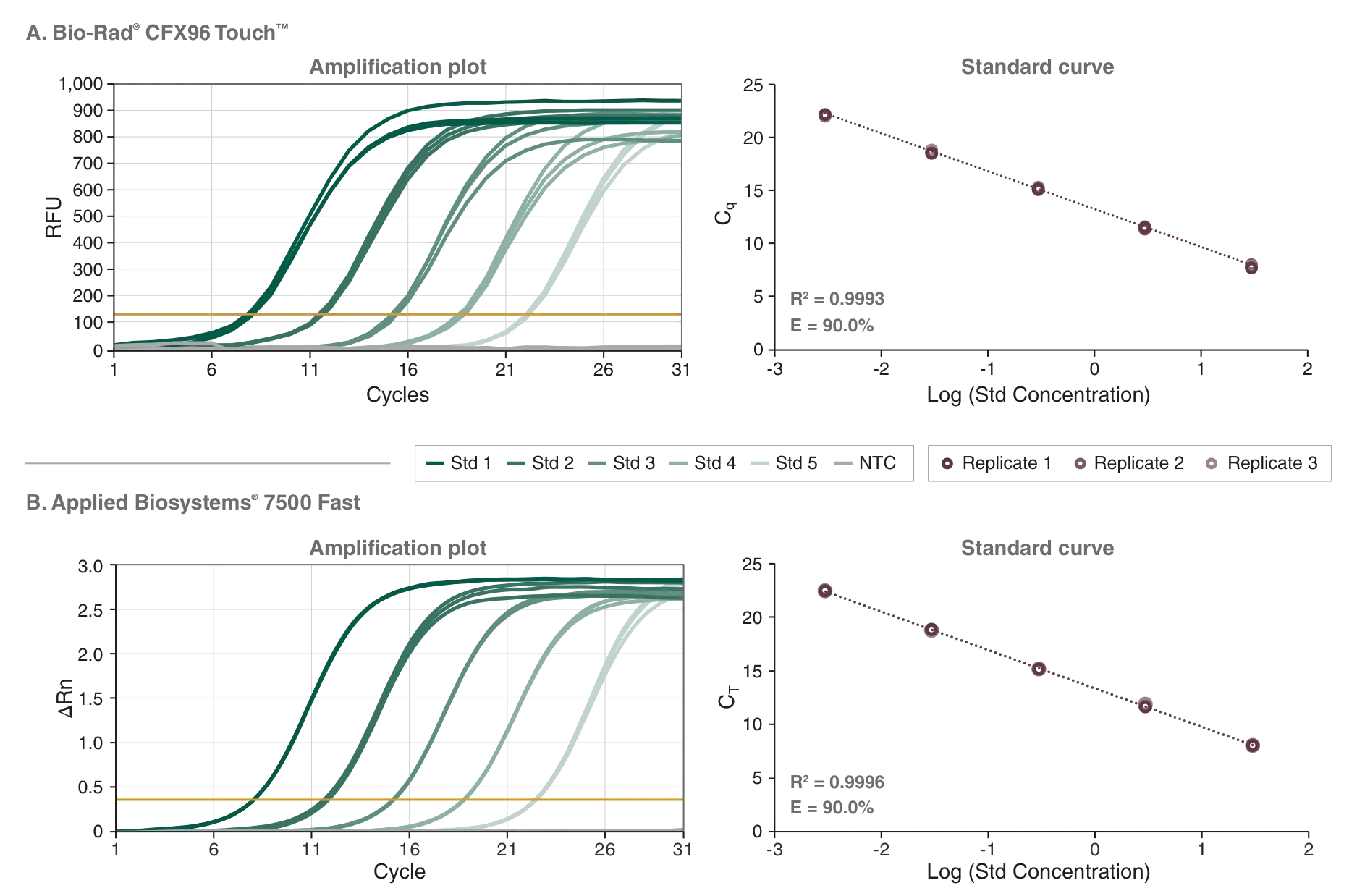
Typical amplification curves for the NEBNext® Library Quant Kit for Ultima Genomics®. Typical results from the NEBNext® Library Quant Kit for Ultima Genomics® on a Bio-Rad® CFX96 Touch™ (A) and an Applied Biosystems® 7500 Fast (B) real-time qPCR instrument. Amplification curves for standards 1-5 (Std 1-5) and no-template control (NTC) are shown on the left and resulting standard curves with linear fit on the right. Default settings for SYBR® Green based quantitation were used on both platforms. All standards were assayed in triplicates. Linear fit for the data provided an R2 value of ≥ 0.998 demonstrating excellent linearity of the standards with an efficiency of 90%.
Figure 3. Tighter distribution of sequencing reads with qPCR-based pooling
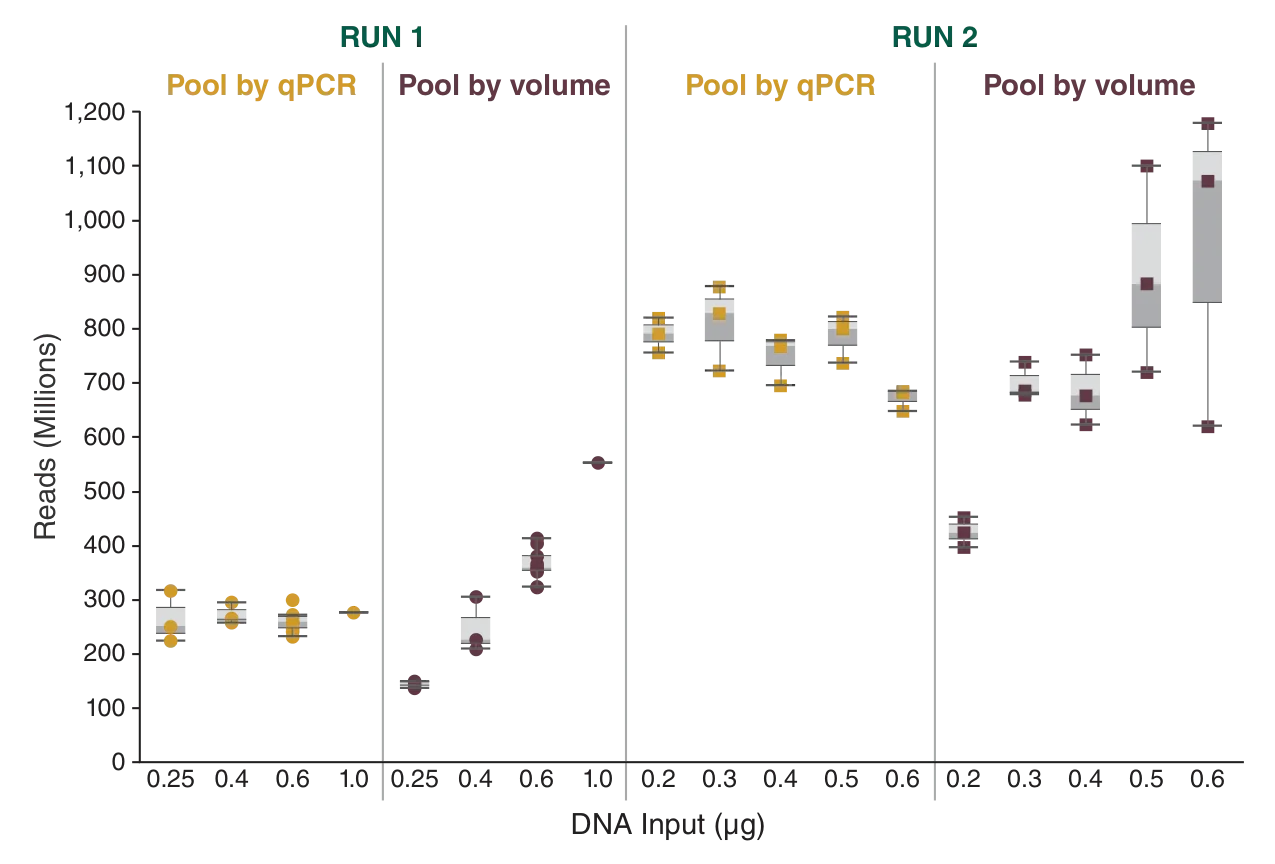
qPCR-based pooling of libraries results in a tighter distribution of sequencing reads compared to volume-based pooling. PCR-free libraries generated from 7 different DNA input amounts (1 µg, 0.6 µg, 0.5 µg, 0.4 µg, 0.3 µg, 0.25 µg and 0.2 µg) were pooled based on either volume or qPCR quantitation and sequenced on two UG 100TM wafers. Box plots show the distribution of reads per library. Pooling based on qPCR quantitation demonstrates a much tighter distribution of reads across input amounts compared to volume-based pooling.
- This product is related to the following categories:
-
Library Preparation for Ultima Genomics,
-
NGS Library Quantitation,
-
Next Generation Sequencing Library Preparation,