Description
Thermolabile Proteinase K is a recombinantly engineered, subtilisin-related serine protease that will hydrolyze a variety of peptide bonds. Unlike other Proteinase K versions that can only be partially inactivated by heat, Thermolabile Proteinase K can be entirely heat-inactivated, allowing for simpler, more efficient workflows, without the need for additional purification steps to remove the enzyme. Thermolabile Proteinase K maintains similar activity and specificity to the wild type version, cleaving peptide bonds at the carboxyl side of most amino acid residues, with some preference at aliphatic or aromatic ones.
Thermolabile Proteinase K (TLPK) can be completely inactivated by incubation at 55°C for 10 minutes, which allows for subsequent enzymatic steps in the same reaction vessel.
Figure 1: No remaining activity of Thermolabile Proteinase K after heat inactivation
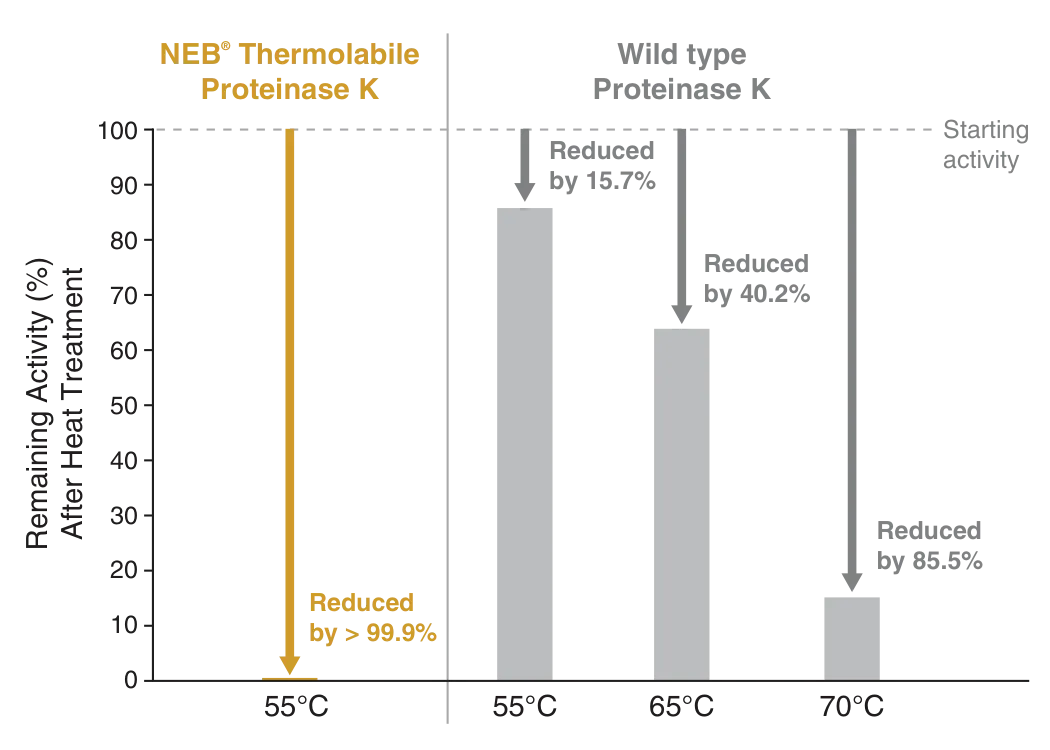
NEB's Thermolabile Proteinase K can be completely (> 99.9%) heat inactivated at only 55°C for 10 minutes compared to wild-type Proteinase K with only partial inactivation, even at higher temperatures. Enzymes were diluted and heated in 20 mM Tris/HCl pH 7.5 and 1 mM of CaCl2, at concentrations that are typical to their respective reaction conditions.
Figure 2: Heat Inactivation of Thermolabile Proteinase K vs. other Proteinase K options
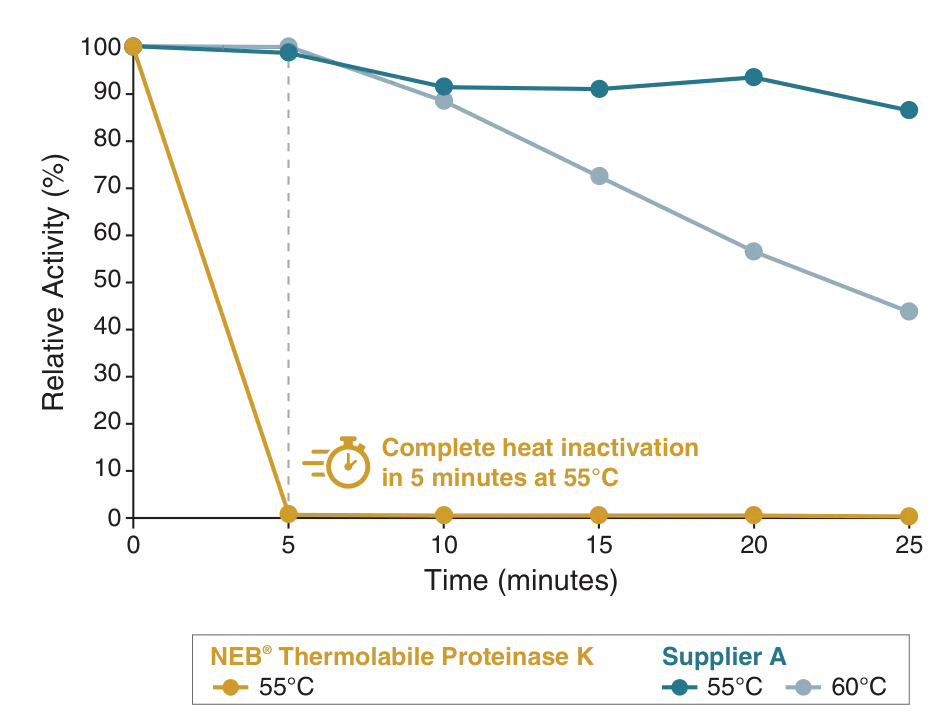
NEB’s Thermolabile Proteinase K can be completely heat inactivated at 55°C in minutes, while another supplier’s proteinase featuring heat-inactivation capabilities retains substantial residual activity after heated at 55°C or 60°C for 25 minutes.
Figure 3: Thermolabile Proteinase K completely degrades restriction enzyme activity
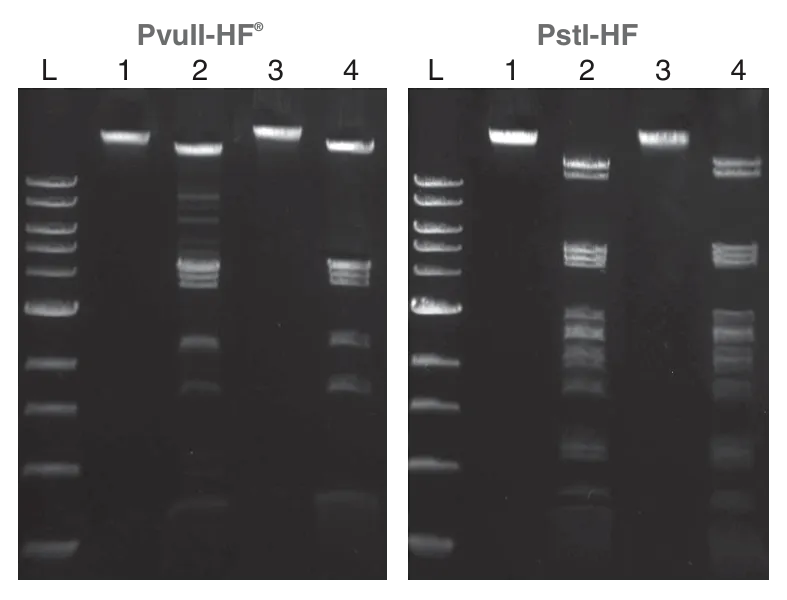
Lane L: 1 kb DNA Ladder (NEB #N3232); Lane 1: λ DNA incubated for 1 hour at 37°C; Lane 2: λ DNA incubated with PvuII-HF or PstI-HF for 1 hour at 37°C; Lane 3: λ DNA incubated with PvuII-HF or PstI-HF which had been treated with 1 μL Thermolabile Proteinase K (TLPK) for 10 minutes at 37 °C; Lane 4: λ DNA incubated first with TLPK treated PvuII-HF or PstI-HF followed by incubation at 55 °C for 10 minutes to inactivate the TLPK, followed by treatment with PvuII-HF or PstI-HF for 1 hour at 37°C. Results indicate that Thermolabile Proteinase K completely degrades restriction enzyme activity, allowing for subsequent enzymatic steps in the same reaction vessel.
Using Thermolabile Proteinase K instead of magnetic beads for cleanup in DNA or RNA library prep keeps the reaction in a single tube, streamlining workflows, improving yield, and reducing costs. This eliminates multiple wash steps, minimizes sample loss, and prevents enzyme carryover between steps. It's especially beneficial for low-input samples, automation, and high-throughput applications.
Product Source
Cloned from Engyodontium album (formerly Tritirachium album), mutagenized to increase thermolability of the enzyme and expressed in Pichia pastoris.
- This product is related to the following categories:
-
Protein Tools,