Description
Bst-XT WarmStart Multi-Purpose LAMP/RT-LAMP 2X Master Mix (with UDG) provides a one-step solution for amplification of DNA (LAMP) or RNA (RT-LAMP) targets. It features a blend of Bst-XT WarmStart DNA Polymerase and WarmStart RTx Reverse Transcriptase in an optimized, fully buffered master mix. Bst-XT WarmStart DNA Polymerase is an engineered variant of Bacillus stearothermophilus DNA Polymerase, Large Fragment fused to a novel nucleic acid binding domain for improved isothermal amplification performance. Bst-XT combines the high specificity of Bst 2.0 and the fast polymerization speed of Bst 3.0 DNA polymerases. WarmStart RTx Reverse Transcriptase is a unique, in silico designed RNA-directed DNA polymerase coupled with a reversibly-bound aptamer that inhibits enzyme activity below 40°C.
Comparison of LAMP master mix products
| |
WarmStart® LAMP Kit (DNA & RNA)
NEB #E1700 |
WarmStart Fluorescent LAMP/RT-LAMP Kit
(with UDG)
NEB #E1708 |
WarmStart Multi-Purpose LAMP/RT-LAMP 2X Master Mix (with UDG)
NEB #M1708 |
Bst-XT WarmStart™ Multi-Purpose LAMP/RT-LAMP 2X Master Mix (with UDG)
NEB #M1712 |
| DNA polymerase |
Bst 2.0 WarmStart |
Bst 2.0 WarmStart |
Bst 2.0 WarmStart |
Bst-XT WarmStart |
| Reverse transcriptase |
WarmStart RTx |
WarmStart RTx |
WarmStart RTx |
WarmStart RTx |
| LAMP fluorescent dye |
Provided |
Provided |
Sold separately |
Sold separately |
| Amplification speed |
★★★ |
★★★ |
★★★ |
★★★★★ |
| Specificity |
★★★★★ |
★★★★★ |
★★★★★ |
★★★★★ |
| Carryover contamination prevention |
No |
Yes |
Yes |
Yes |
| Room temperature set-up |
Enabled |
Enabled |
Enabled |
Enabled |
| Optimal LAMP temperature |
60-70°C |
60-70°C |
60-70°C |
50-70°C |
★★★★★ = optimal, recommended product for selected application
★★★ = will perform selected application
The mix is compatible with different sample types and enables multiple detection methods including real-time fluorescence detection (when used with LAMP fluorescent dye) and end-point visualization such as colorimetric detection via a metal sensing dye (e.g., calcein.)
The inclusion of dUTP and thermolabile UDG reduces the possibility of carryover contamination, where unintended product of a previous amplification serves as the substrate of a subsequent reaction. Thermolabile UDG is completely inactivated at temperatures above 50°C, thereby having no effect on the reaction.
Figure 1: Bst-XT WarmStart Multi-Purpose LAMP/RT-LAMP 2X Master Mix (with UDG) enables faster DNA or RNA target detection compared to similar NEB LAMP master mixes
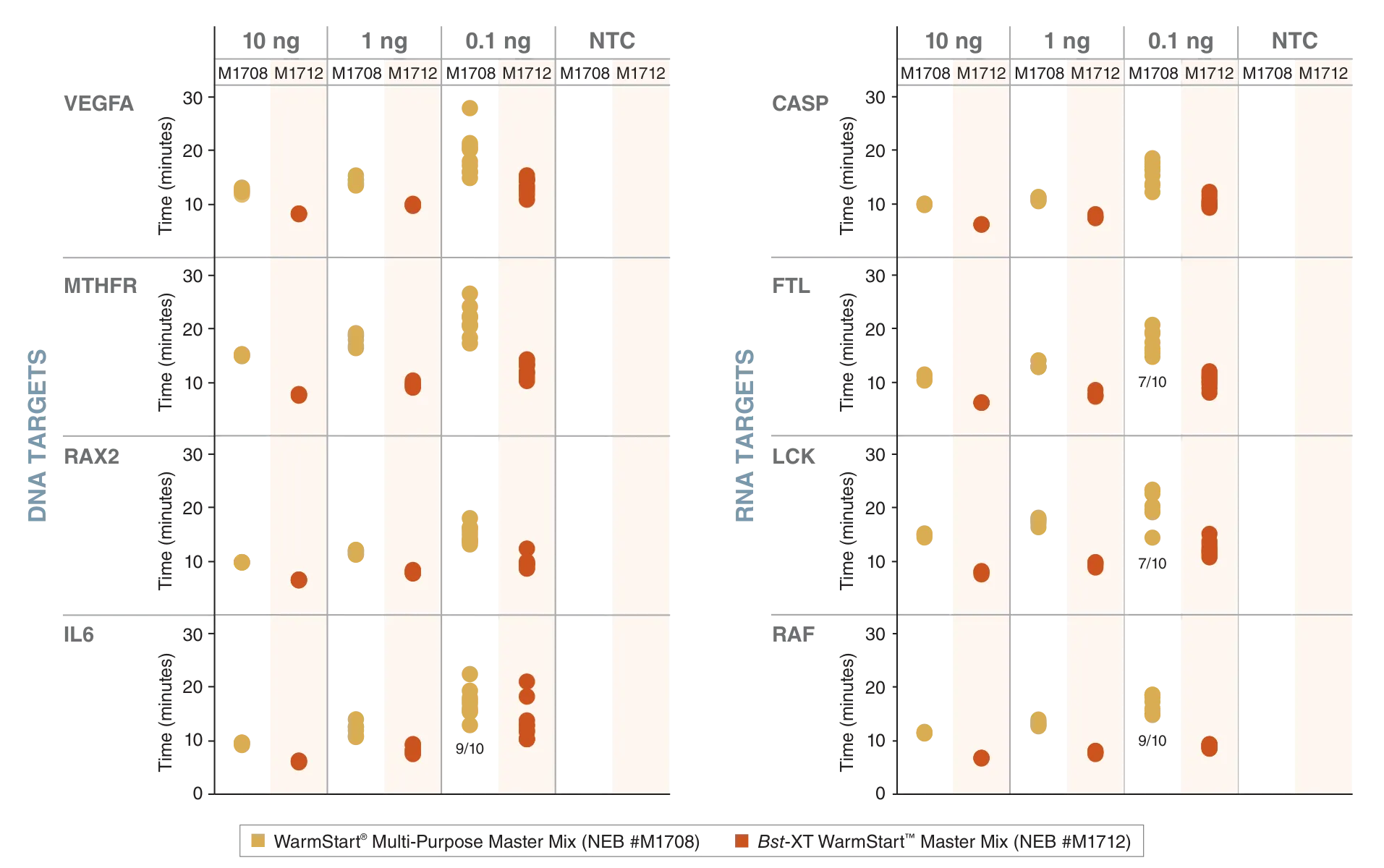
RT-LAMP (RNA targets) and LAMP (DNA targets) experiments were performed with different Bst master mix products. Reactions containing 1X LAMP primers and 0.5X LAMP Fluorescent Dye (NEB #E1700) were set up over three logs of human Jurkat total RNA or Jurkat gDNA (10 ng to 0.1 ng) in 96-well, 25 µl reactions. Control reactions without template (NTC) were also evaluated. The number of replicates for the 10, 1, 0.1 ng or NTC reactions were 4, 6, 10 and 4, respectively. Reactions were incubated at 65°C for 30 minutes and fluorescence was monitored every 15 seconds in the SYBR/FAM channel of a real-time thermocycler (Bio-Rad® CFX Opus 96). Each dot represents the time at which the fluorescence signal for a single reaction crosses the instrument-defined threshold. All replicates were detected at a given template input unless otherwise indicated (note that dots frequently overlap due to similar detection time for the replicates). The Bst-XT WarmStart master mix (orange dots) consistently showed faster and more sensitive, specific detection across all template inputs compared to a WarmStart master mix containing Bst 2.0 (gold dots) for both DNA targets (left panel) and RNA targets (right panel).
Figure 2: Bst-XT WarmStart Multi-Purpose LAMP/RT-LAMP 2X Master Mix (with UDG) enables faster LAMP reactions across a wider temperature range than similar NEB LAMP master mixes
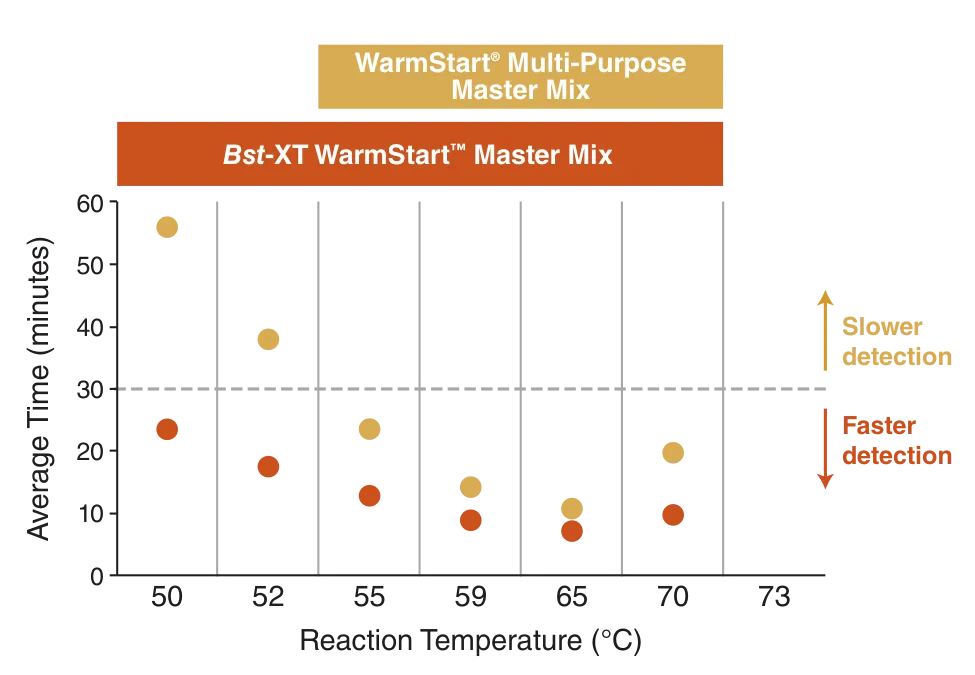
A LAMP experiment (DNA target VEGFA) was performed using different Bst master mixes. Reactions were set up containing 1X LAMP primers, 0.5X LAMP Fluorescent Dye (NEB #E1700), and 1 ng of Jurkat gDNA in 96-well, 25 µl reactions. Reactions were incubated at temperatures ranging between 50–74°C for 60 minutes and fluorescence was monitored every 15 seconds in the SYBR/FAM channel of a real-time thermocycler (Bio-Rad® CFX Opus 96). Each dot represents the average of three replicates for time to detection, which is the time at which the fluorescence signal crosses the instrument-defined threshold. The Bst-XT WarmStart master mix was able to detect 1 ng of target within 30 minutes at reaction temperatures ranging from 50–70°C while the WarmStart master mix containing Bst 2.0 showed detection within 30 minutes at temperatures between 55–70°C. This data highlights that the Bst-XT master mix can be used to perform LAMP reactions across a broader range of temperatures, maintaining faster amplification speed at lower reaction temperatures.
Figure 3: Bst-XT WarmStart Multi-Purpose LAMP/RT-LAMP 2X Master Mix (with UDG) supports endpoint colorimetric detection using metal sensing dyes, including Eriochrome Black T (EBT) or Calcein
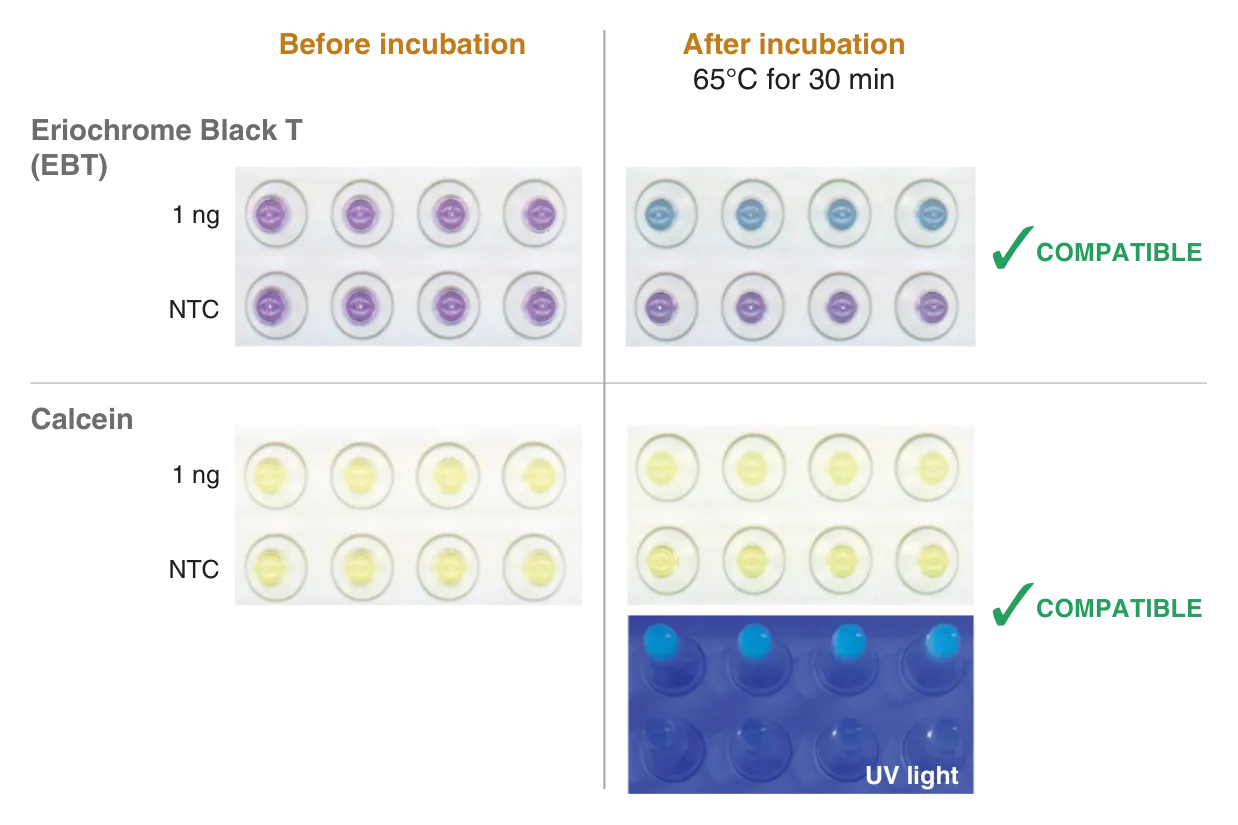
The Bst-XT master mix was used to perform an RT-LAMP experiment using 1X LAMP primers to amplify a human RNA target (CASP) at 1 ng template input in the presence of either Calcein:MnCl2 (25 µM Calcein/ 0.5 mM MnCl2), or 60 µM EBT. Control reactions without template (NTC) were also included for each detection component. The 25 µl reactions were incubated at 65°C for 30 minutes before being visually inspected. EBT and Calcein/MnCl2 showed visible color change for template-containing reactions and provided good color contrast compared to the NTCs. Reactions containing EBT were purple prior to incubation. Post-incubation, amplified samples turned blue while NTCs remained purple. When Calcein was used, the color change in template-containing reactions was visibly distinguishable from NTCs (bright yellow for amplified reactions and light orange for NTCs); however, the distinction is seen more clearly under UV light.
Figure 4: Broad Infectious Disease RNA Detection with Bst-XT WarmStart Multi-Purpose LAMP/RT-LAMP 2X Master Mix (with UDG)
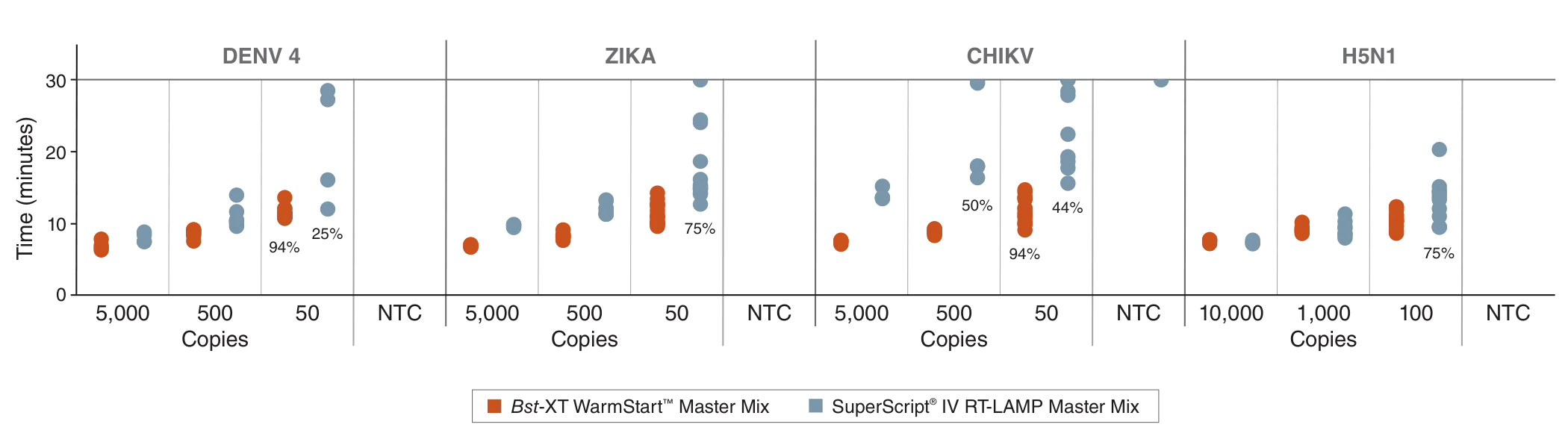
Performance was evaluated using 5000 to 50 copies of ATCC® synthetic viral RNA (Dengue-4 Virus: VR3231SD, Chikungunya Virus: VR-3246SD) or total RNA extracts (Zika Virus: 1843DQ) diluted in 4 ng/μl human Jurkat total RNA in a single-plex reaction. Twist Synthetic Influenza A (H5N1) RNA Control was detected at concentrations ranging from 10,000 to 100 copies. N = 4 for reactions with 10,000 or 5,000 copies, N = 8 for 1,000 or 500 copies, N = 16 for 100 or 50 copies, and N = 4 for NTCs. 25 µl reactions containing 1X LAMP primers designed for each target were set up in 96-well plates. The Bst-XT master mix reactions contained 0.5X LAMP Fluorescent Dye (NEB #E1700) while SuperScript® IV RT-LAMP Master Mix reactions were prepared using SYTO 9 following the manufacturer’s protocol. Reactions were incubated at 65°C for 30 minutes and fluorescence was monitored every 15 seconds in the SYBR/FAM channel of a real-time thermocycler (Bio-Rad® CFX Opus 96). Each dot represents the time at which the fluorescence signal for a single reaction crosses the instrument-defined threshold. All replicates were detected at a given template input unless otherwise indicated (note that dots frequently overlap due to similar detection time for the replicates. The Bst-XT master mix enabled fast and sensitive detection, achieving a higher percent detection at low input levels across all synthetic viral RNA targets compared to SuperScript IV RT-LAMP Master Mix.
Figure 5: Bst-XT WarmStart Multi-Purpose LAMP/RT-LAMP 2X Master Mix (with UDG) maintains speed and specificity after room temperature setup
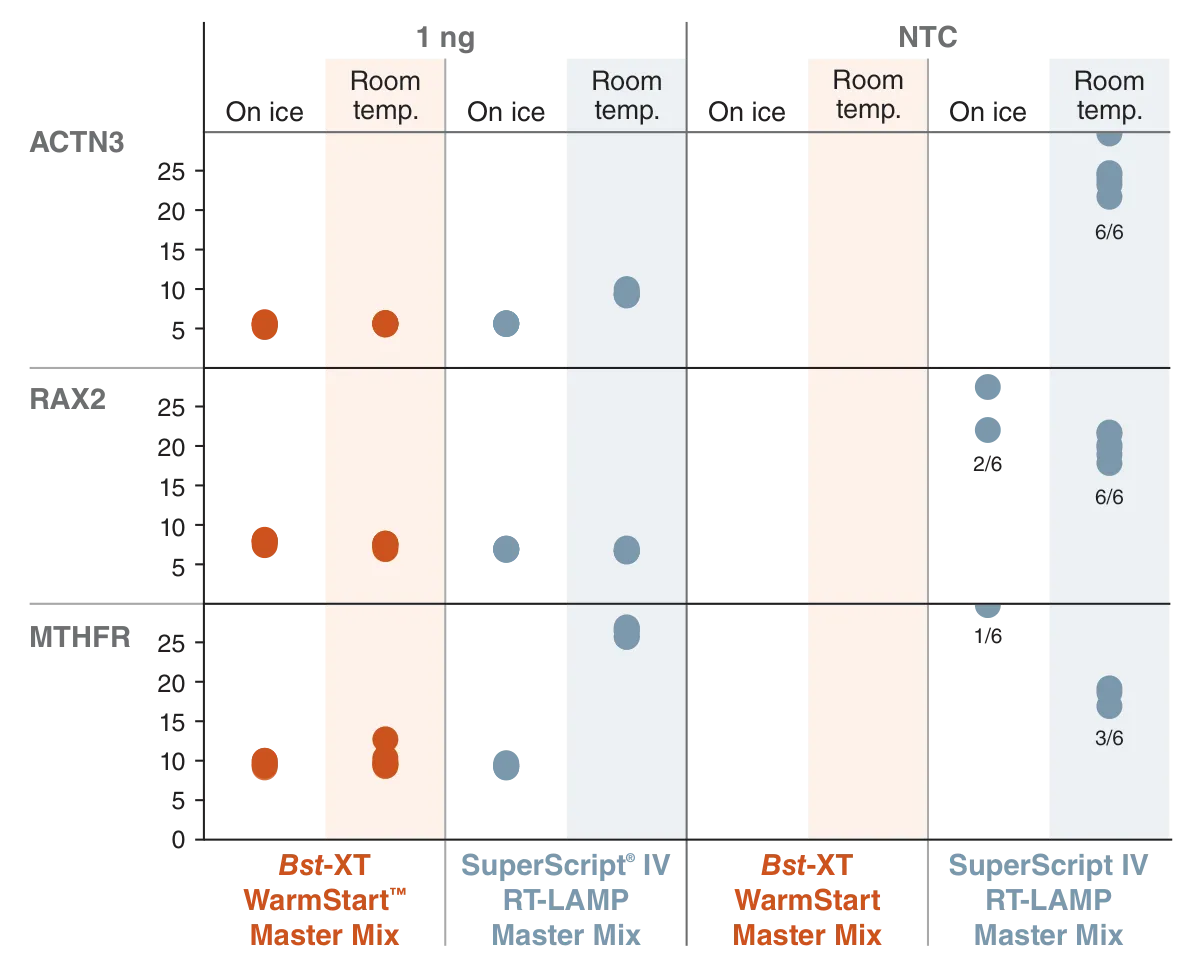
LAMP reactions were run with 1X LAMP primers to detect three human DNA targets in 96-well, 25 µl reactions, using 1 ng of Jurkat gDNA as template (N=6). Non-template controls (NTCs) were also included (N=6), and the number of amplified NTCs is indicated on the graph. Bst-XT master mix reactions contained 0.5X LAMP Fluorescent Dye (NEB #E1700) while SuperScript® IV RT-LAMP Master Mix reactions were prepared using SYTO 9, following the manufacturer’s protocol. Reactions were incubated at 65°C for 30 minutes and fluorescence was monitored every 15 seconds in the SYBR/FAM channel of a real-time thermocycler (Bio-Rad® CFX Opus 96). To compare reaction setups on ice versus room temperature, two identical plates were prepared: one plate was setup on ice and run immediately, while the second plate was incubated at room temperature for 1.5 hours prior to initiating the LAMP reaction. Time-to-detection results following room temperature incubation are highlighted with shaded columns in the graph. The Bst-XT master mix exhibited superior specificity with no NTC amplification and showed nearly identical time-to-detection values for template-containing reactions across all three DNA targets following room temperature incubation. These data highlight the benefit of the WarmStart enzymes, enabling room temperature set up without a loss of performance.
- This product is related to the following categories:
-
Isothermal Amplification & Strand Displacement
- This product can be used in the following applications:
-
Isothermal Amplification