Description
The Nucleoside Digestion Mix is a mixture of enzymes that provides a convenient one-step method to generate single nucleosides from DNA or RNA. Optimized for quantitative analysis by liquid chromatography-mass spectrometry (LC-MS), this reagent eliminates the need for sequential multi-step, time-consuming digestion protocols. The Nucleoside Digestion Mix digests ssDNA, dsDNA, DNA/RNA hybrids and RNA (except mRNA cap structures) containing epigenetically modified (m5C, hm5C, f5C, ca5C, m4C, m6A, etc.), unnatural, or damaged bases. Moreover, the low-glycerol formulation (<1%) significantly reduces glycerol-induced ion suppression during mass spectrometry analysis.
Supplied in: 20 mM Tris-HCl (pH 7.5), 1 mM MgCl2, 2 mM CaCl2, 2 mM ZnCl2, 50 mM NaCl and 0.6% glycerol.
Figure 1: Global nucleoside analysis of HeLa DNA following incubation with the Nucleoside Digestion Mix
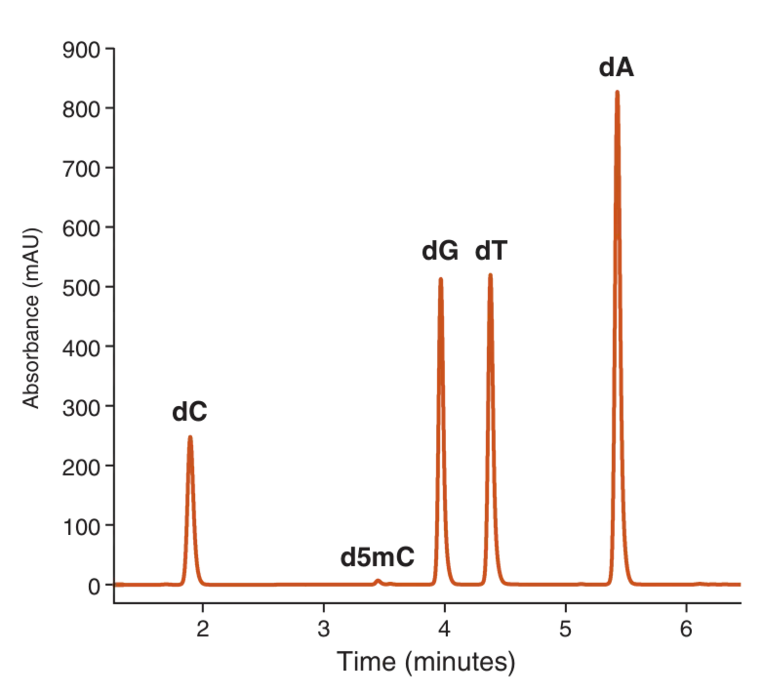
Representative HPLC chromatogram of individual deoxyribonucleosides obtained from incubation of 1 µg of purified genomic HeLa DNA digested with 1 µl of the Nucleoside Digestion Mix for 1 hour at 37°C. Deoxyribonucleosides were separated by reversed-phase HPLC and detected by UV absorbance at 260 nm.
Figure 2: Global nucleoside analysis of HEK 293 RNA following incubation with the Nucleoside Digestion Mix
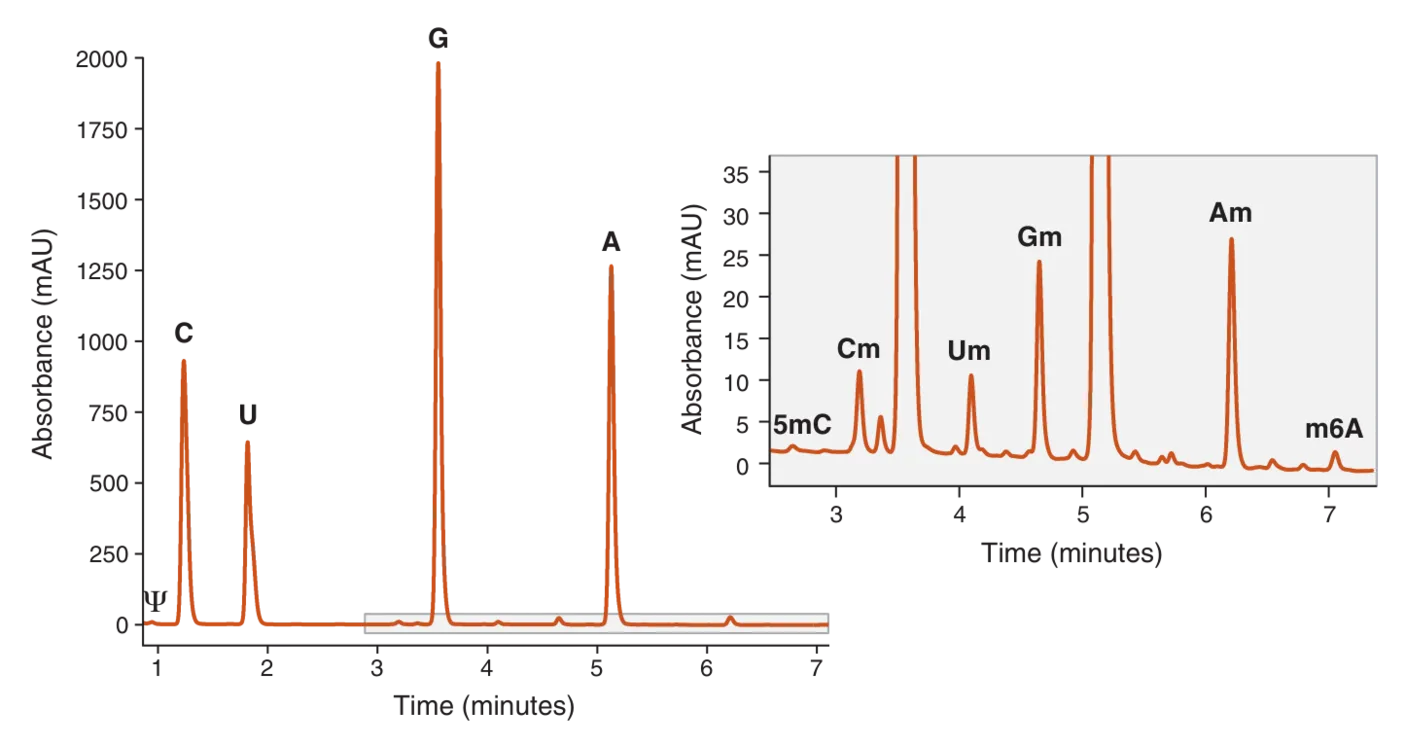
Representative HPLC chromatogram of individual ribonucleosides obtained from incubation of 1 µg of purified genomic HEK 293 RNA digested with 1 µl of the Nucleoside Digestion Mix overnight at 37°C. Ribonucleosides were separated by reversed-phase HPLC and detected by UV absorbance at 260 nm. The insert shows an expansion of the chromatogram highlighting the detection of modified ribonucleosides.
Figure 3: The activity of the Nucleoside Digestion Mix remains stable even after 50 freeze-thaws
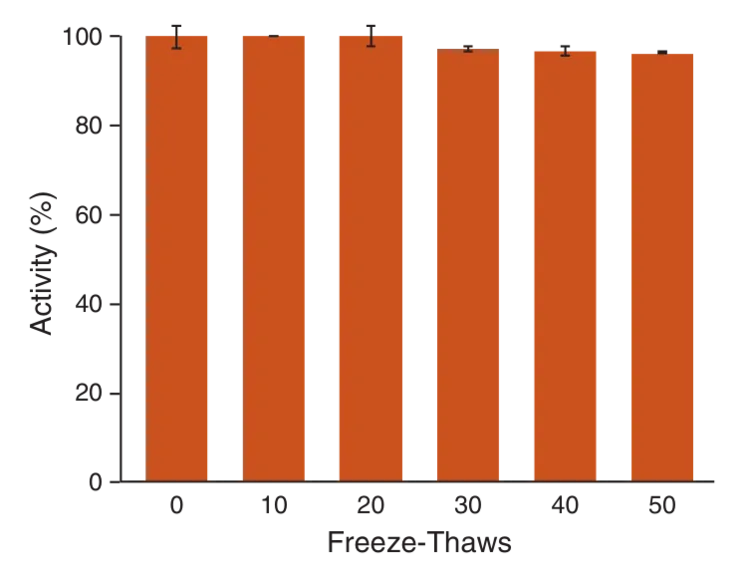
After undergoing multiple freeze-thaw cycles, 1 µl of the Nucleoside Digestion Mix was used to digest 1 µg of λ DNA (NEB #N3011) for 1 hour at 37°C. The nucleoside content of the digested samples was analyzed by LC-MS.
- This product is related to the following categories:
-
Hydroxymethylation Detection and Analysis,
-
Epitranscriptome Analysis,
-
DNA Methylation Analysis,
-
Epigenetics,
-
RNA Modification,
-
DNA Modifying Enzymes & Cloning Technologies,