Description
NEBNext UltraShear Long Read contains reagents to enzymatically fragment gDNA in a time- and temperature-dependent manner generating DNA fragment lengths ranging between 2 kb to 30 kb. These gDNA fragment lengths are compatible with different long-read applications, including the current commercially available platforms from ONT and PacBio.
Like its short-read counterpart NEBNext UltraShear (NEB #M7634), fragmentation with NEBNext UltraShear Long Read maintains methylation marks, making it compatible with methylation analysis workflows. As an alternative to mechanical fragmentation methods like Covaris® gTUBE™, it offers a fast, scalable, user- and automation-friendly workflow requiring minimal hands-on time.
Figure 1: NEBNext UltraShear Long Read is compatible with manual and automated workflows
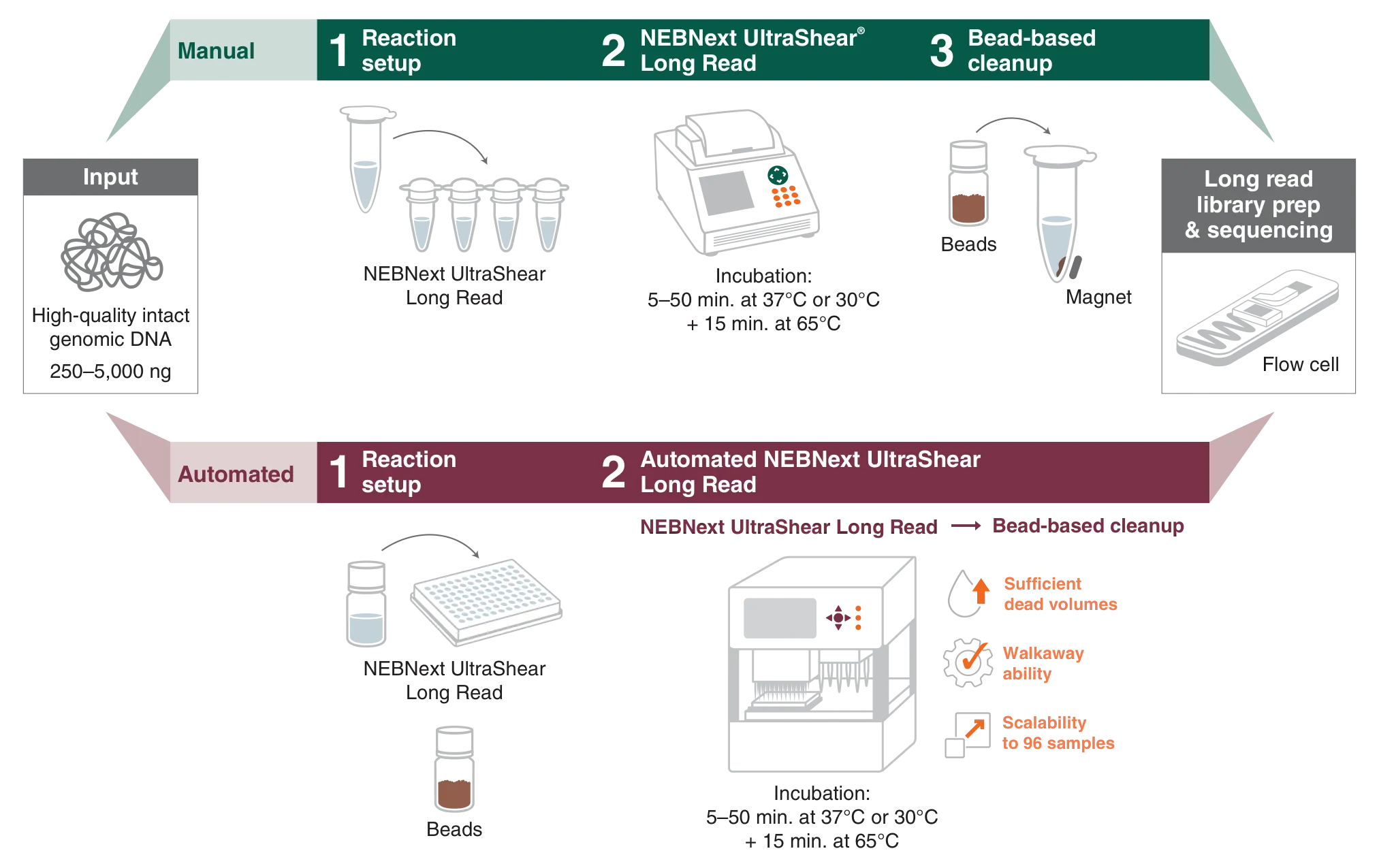
The NEBNext UltraShear Long Read workflow accommodates a wide input range, from 250 ng to 5,000 ng of genomic DNA, and can be completed in as little as 30 minutes. NEBNext UltraShear Long Read is automation friendly with minimal sample transfers, sample tracking flexibility, and sufficient reagent overages to account for automation dead volumes. NEBNext UltraShear Long Read fragmentation integrates seamlessly with Oxford Nanopore Technologies® and PacBio® library preparation and sequencing.
Figure 2: NEBNext UltraShear Long Read fragmentation improves sequencing yield while maintaining N50 values comparable to no fragmentation
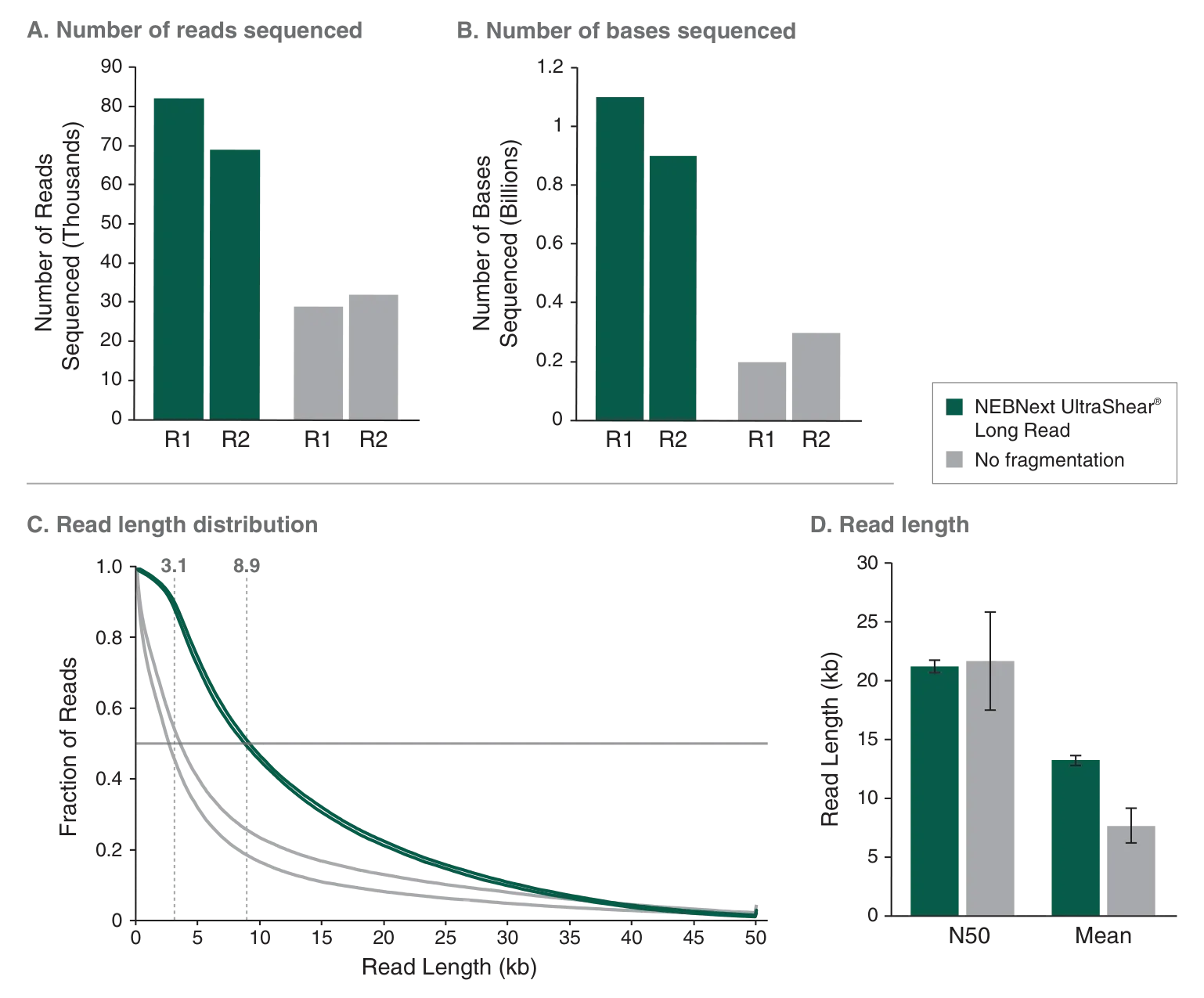
1,000 ng of gDNA (DQN = 9.9), extracted from GM12878 human cells using the Monarch® HMW DNA Extraction Kit for Cells and Blood, was fragmented for 5 minutes at 30°C followed by 15 minutes at 65°C with NEBNext UltraShear Long Read. 100 ng of NEBNext UltraShear Long Read fragmented gDNA and non-fragmented gDNA were used to generate libraries for Oxford Nanopore Technologies (ONT) sequencing. The libraries were prepared with ONT’s Native Barcoding Kit 96 V14 and sequenced on a PromethION ® 2 Solo (P2 Solo) instrument. (A & B) The NEBNext UltraShear Long Read libraries generated higher sequencing yield (number of reads and bases sequenced) compared to the non-fragmentated gDNA libraries. Technical replicates are shown across all conditions. (C) S-shaped curve plotting the fraction of reads at a particular read length or greater (in 100 bp bins). Reads longer than 50 kb are represented as 50 kb. The vertical dash lines represent the read length at 0.50 fraction of reads for both NEBNext UltraShear Long Read and non-fragmented libraires. The libraries generated using NEBNext UltraShear Long Read fragmentation result in a higher proportion of data at longer read lengths compared to non-fragmented libraries. Technical replicates are shown across all conditions. (D) The NEBNext UltraShear Long Read fragmented libraries have similar N50 read lengths and increased mean read lengths compared to non-fragmented libraries. The average of two technical replicates and standard error are shown for each condition.
Figure 3: NEBNext UltraShear Long Read generates high-quality libraries
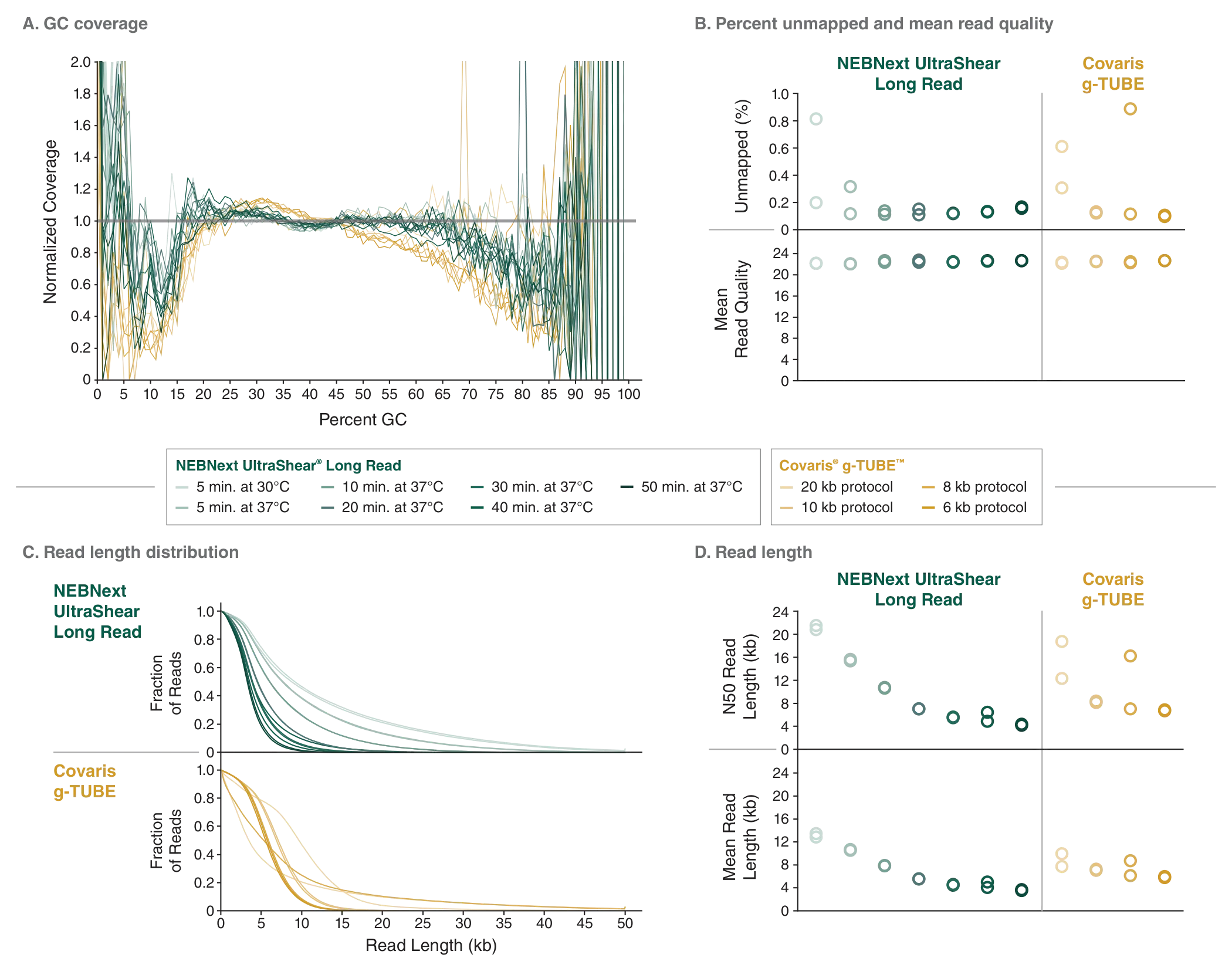
1,000 ng of gDNA (DQN = 9.9), extracted from GM12878 human cells using the Monarch® HMW DNA Extraction Kit for Cells and Blood, was fragmented for 5 minutes at 30°C or 5 to 50 minutes at 37°C followed by 15 minutes at 65°C with NEBNext UltraShear Long Read or with Covaris® g-TUBE™ using the 20 kb, 10 kb, 8 kb or 6 kb protocols. Following fragmentation, 100 ng of fragmented DNA was used to generate libraries for Oxford Nanopore Technologies® (ONT) sequencing. The libraries were prepared with ONT’s Native Barcoding Kit 96 V14 and sequenced on a PromethION® 2 Solo (P2 Solo) instrument. Dorado 0.8.3. was used for ONT base calling and approximately 100 thousand reads were aligned to the human T2T genome. (A) The GC coverage was analyzed using Picard and the distribution of normalized coverage plotted across different GC contents of the genomes (0–100%). Libraries prepared using NEBNext UltraShear Long Read fragmented DNA generate uniform GC coverage across different fragmentation conditions. (B) NEBNext UltraShear Long Read fragmentation conditions produce high-quality ONT libraries and sequencing data (% unmapped and mean read quality). (C) S-shaped curve plotting the fraction of reads at a particular read length or greater (in 100 bp bins) for NEBNext UltraShear Long Read and Covaris g-TUBE conditions. Reads longer than 50 kb are represented as 50 kb. The profile observed within technical replicates for each condition is consistent for gDNA fragmented with NEBNext UltraShear Long Read compared to Covaris g-TUBE. (D) Sequenced N50 and mean read lengths obtained using NEBNext UltraShear Long Read fragmentation conditions are more tunable and reproducible than those achieved with Covaris g-TUBE conditions. Technical replicates are shown across all conditions.
Figure 4: NEBNext UltraShear® Long Read is a time-dependent enzymatic fragmentation method
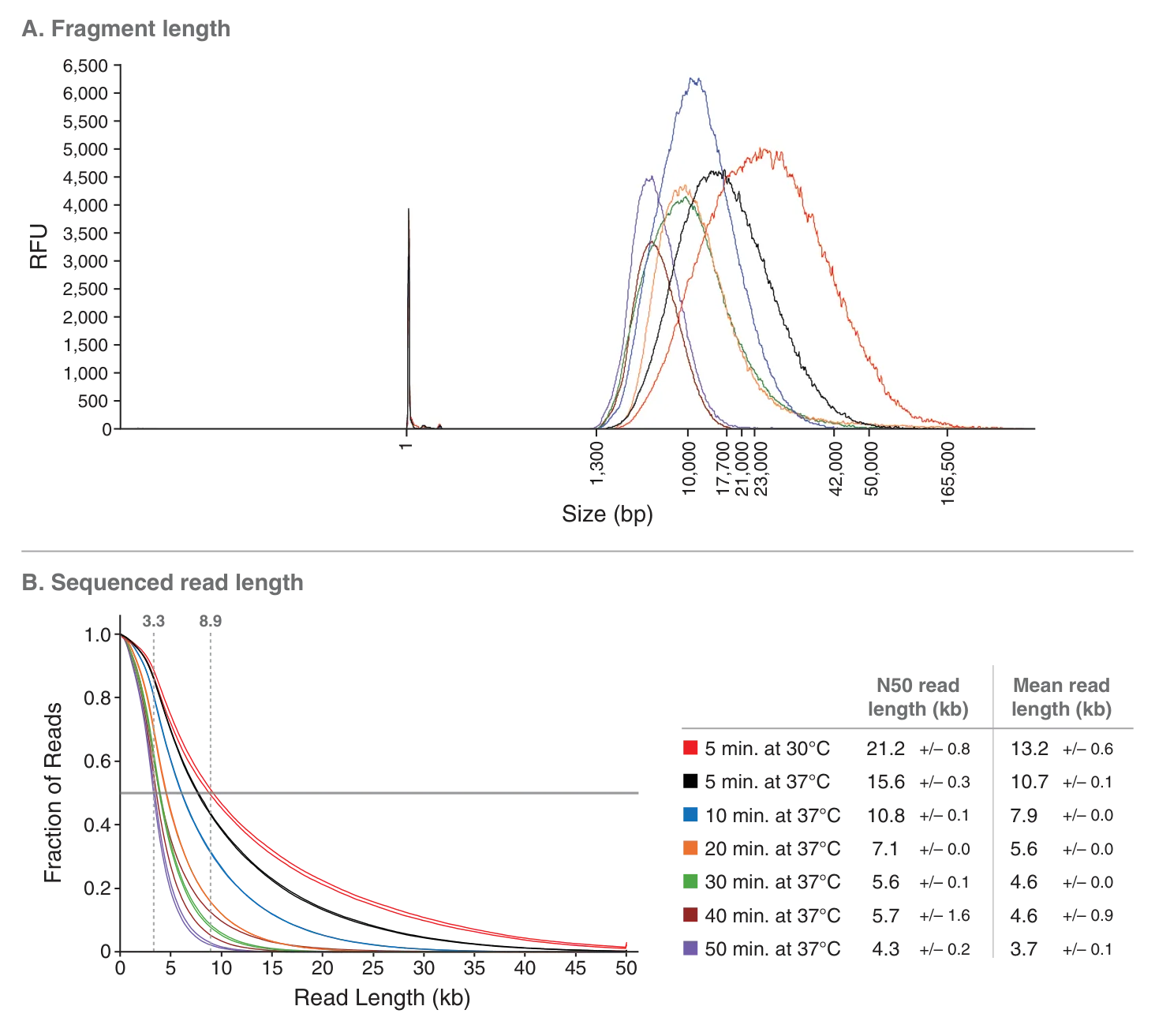
1,000 ng of gDNA (DQN = 9.9), extracted from GM12878 human cells using the Monarch® HMW DNA Extraction Kit for Cells and Blood, was fragmented for 5 minutes at 30°C or 5 to 50 minutes at 37°C followed by 15 minutes at 65°C with NEBNext UltraShear Long Read. (A) Agilent® Femto Pulse® trace (165kb protocol) showing the time-dependent shifts in fragmentation size and profile of gDNA fragmented using NEBNext UltraShear Long Read. Following fragmentation, 100 ng of fragmented DNA was used to generate libraries for Oxford Nanopore Technologies® (ONT) Sequencing. The libraries were prepared using ONT’s Native Barcoding Kit 96 V14 and sequenced on a PromethION® 2 Solo (P2 Solo) instrument. (B) S-shaped curve plotting the fraction of reads at a particular read length or greater (in 100 bp bins), across different fragmentation conditions. Reads longer than 50 kb are represented as 50 kb. The vertical dash lines represent the read length at 0.50 fraction of reads for libraries generated using gDNA fragmented for 5 minutes at 30°C and 50 minutes at 37°C, showcasing the tunability of NEBNext UltraShear Long Read. Technical replicates are shown across all conditions. The table summarizes the sequenced N50 and mean read lengths across different fragmentation conditions. The average of two technical replicates and standard error are shown for each condition.
Figure 5: NEBNext UltraShear Long Read fragmentation generates even GC Coverage for different gDNA samples on Oxford Nanopore Technologies® and PacBio® platforms
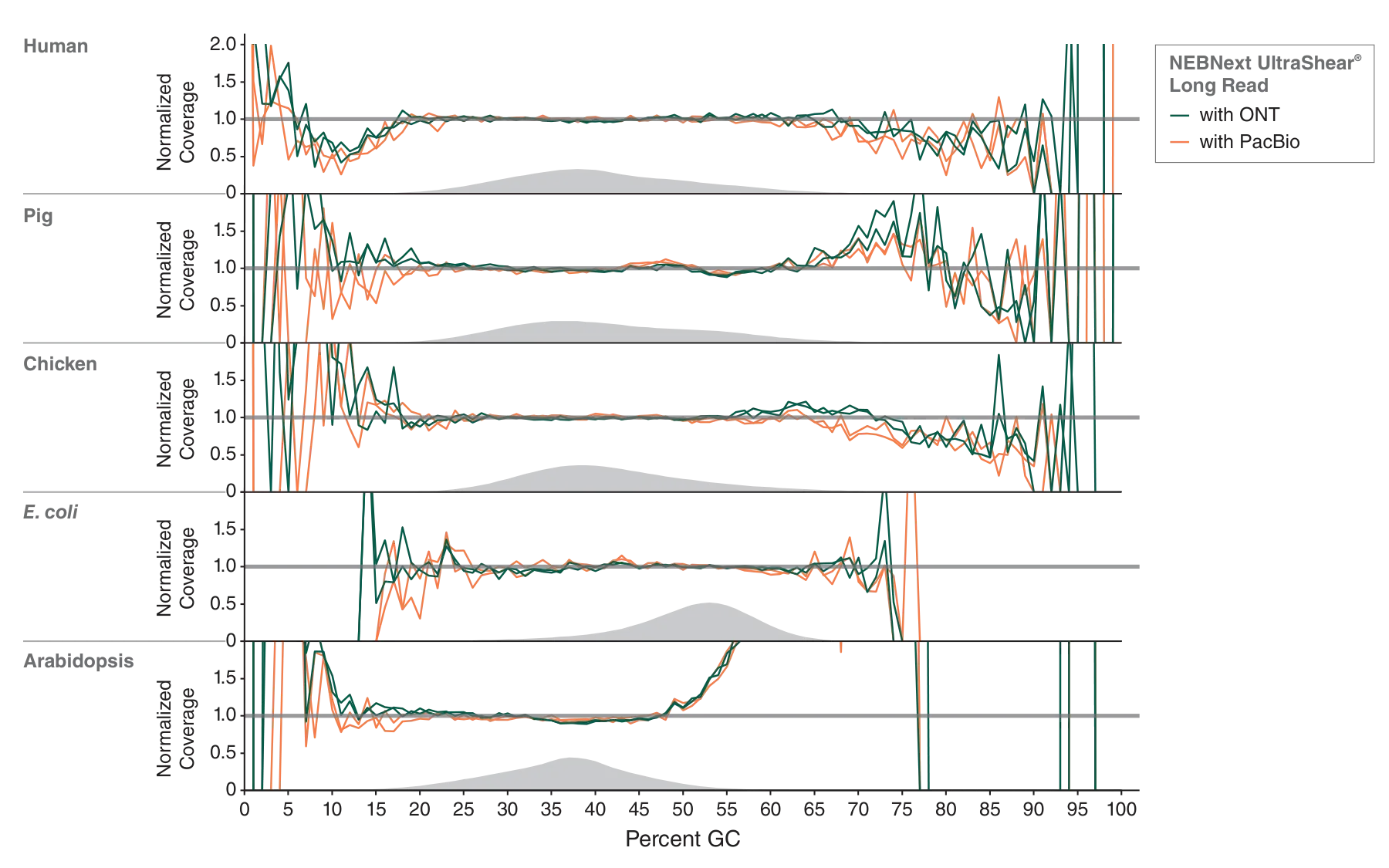
1,000 ng of gDNA from different species (human, pig, chicken, E. coli, and Arabidopsis) was fragmented for 5 minutes at 37°C followed by 15 minutes at 65°C with NEBNext UltraShear Long Read. Following fragmentation,100 ng of fragmented DNA was used to generate libraries with Oxford Nanopore Technologies (ONT) Native Barcoding Kit 96 V14 and sequenced on a PromethION® 2 Solo (P2 Solo) instrument (green), or with PacBio SMRTbell® prep kit 3.0 and sequenced on a PacBio Sequel® II Instrument (orange). Dorado 0.8.3. was used for ONT basecalling and approximately 100 thousand reads for ONT libraries and 60 thousand reads for the PacBio libraries were aligned to the appropriate genomes (Human T2T, s_scrofa_v11.1, Gallus_gallus, eschColi_BL21, and CoICEN respectively) using Minimap 2. The GC coverage was analyzed using Picard and the distribution of normalized coverage plotted across different GC contents of the genomes (0–100%). The libraries generated using NEBNext UltraShear Long Read fragmented DNA have uniform GC coverage across different gDNA samples for both ONT and PacBio platforms. Technical replicates are shown across all conditions.
Figure 6: NEBNext UltraShear Long Read maintains DNA methylation
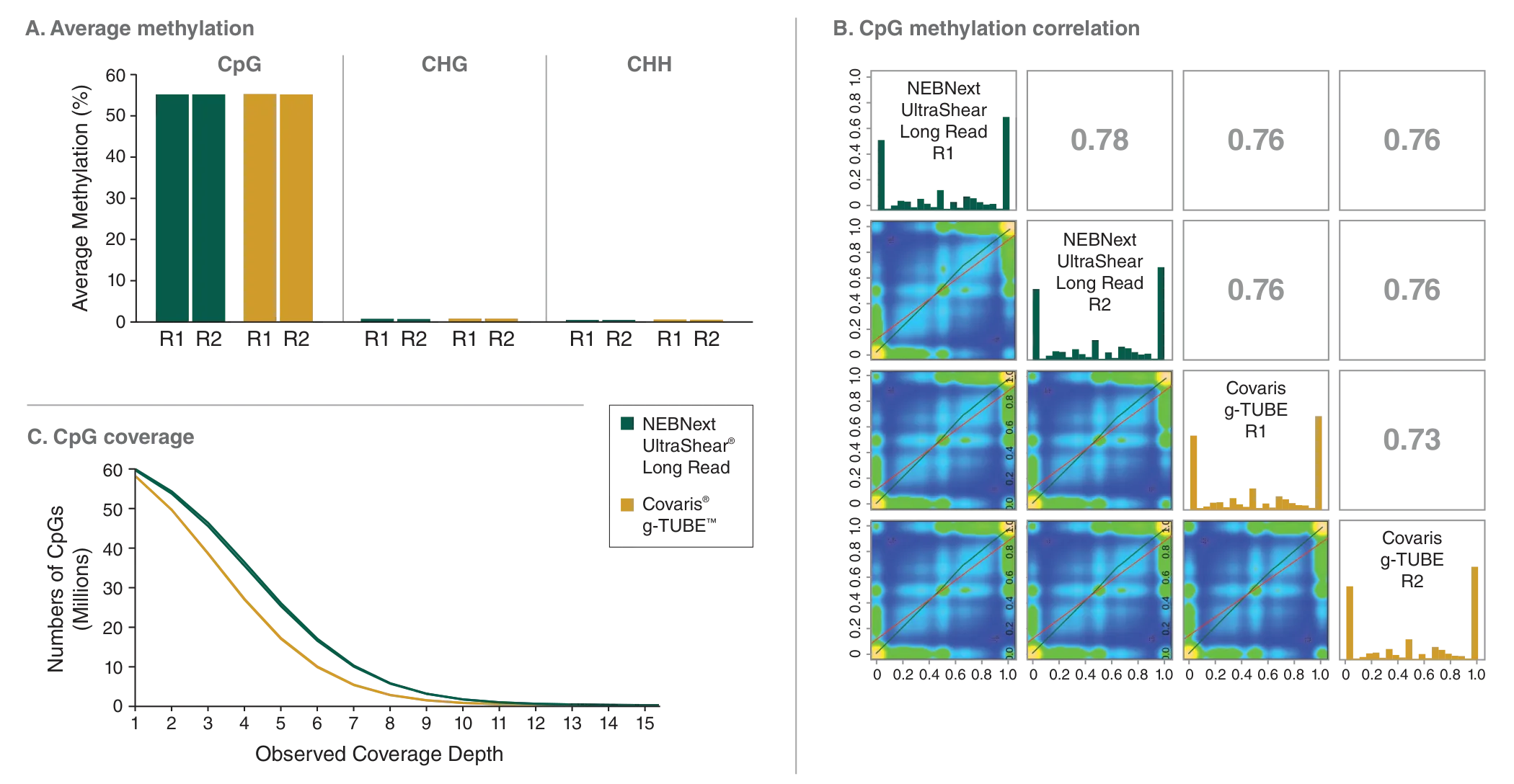
1,000 ng of GM12878 gDNA (commercially purchased salting out extraction; DQN = 8.8) was fragmented with NEBNext UltraShear Long Read (5 minutes at 30°C followed by 15 minutes at 65°C) or Covaris g-TUBE (20kb protocol) with two technical replicates each. Following fragmentation, 400 ng of fragmented DNA was used to generate libraries for Oxford Nanopore Technologies® (ONT) sequencing. The libraries were prepared with ONTs Native Barcoding Kit 96 V14 and sequenced on a PromethION® 2 Solo (P2 Solo) instrument. The data was combined from six PromethION flow cells. Dorado 0.9.1 was used for basecalling and approximately 4 million reads were aligned using Minimap2 to the Human T2T reference. (A) The percent of aggregated methylation in all contexts are similar for libraries prepared using NEBNext UltraShear Long Read and Covaris g-TUBE. (B) CpG methylation correlations were generated for libraries prepared using NEBNext UltraShear Long Read-fragmented and Covaris g-TUBE-sheared gDNA using methylKit. Approximately 52 million CpGs were common to all libraries at a 1X sequencing depth. There is high correlation between CpG methylation of NEBNext UltraShear Long Read and Covaris g-TUBE libraries. (C) Approximately, 60 million and 58 million CpGs were identified at 1X coverage for libraries generated using NEBNext UltraShear Long Read and Covaris g-TUBE respectively. NEBNext UltraShear Long Read enables coverage of higher number of CpGs compared to Covaris g-TUBE at varying coverage depth. The average coverage of ~10X for both fragmentation methods was obtained by combining data from six PromethION flow cells sequenced for 72 hours.
More data supporting the claims made about the NEBNext UltraShear Long Read product can be found on the E3430 Supplemental Data Page.
- This product is related to the following categories:
-
Library Preparation for Oxford Nanopore Technologies,
-
DNA Fragmentation,
-
Next Generation Sequencing Library Preparation,